
Search
Category
Related Industries
- How slag viscosity affects entrained flow gasifier performanceDiscover how slag viscosity affects entrained flow gasifier drainage, efficiency, and wall durability—and learn what to evaluate for more reliable operation.
- How to assess oversupply risk with olefins market intelligenceUse olefins market intelligence to assess oversupply risk through capacity, demand, costs, and trade flows. Discover how to strengthen procurement and investment decisions.
- How grid bottlenecks shape energy infrastructure investment in EuropeExplore energy infrastructure Europe can rely on: discover how grid bottlenecks, connection risks and storage economics shape investment decisions and project value.
Weekly Insights
Stay ahead with our curated technology reports delivered every Monday.
When do carbon-neutral chemical solutions make financial sense?




Carbon-neutral chemical solutions make financial sense when they improve the economics of an existing asset or protect the cash flows that justify its continued operation. The relevant comparison is not “low-carbon versus conventional” in principle. It is the incremental capital required against a credible baseline of energy costs, carbon liabilities, maintenance exposure, product-market requirements, financing conditions, and residual asset value.
A project with a higher purchase price can still be the lower-cost decision if it reduces fuel consumption in a heat-intensive process, removes a future emissions cost from a product margin, avoids a costly compliance retrofit, or preserves access to customers that require verified lower-carbon materials. Conversely, a technically attractive solution is not financially sound merely because it has a favorable carbon narrative. If its savings depend on an uncertain green-power supply, a premium that is not contractually secured, or a carbon-price assumption that management would not use in ordinary investment decisions, the project should be treated as a strategic option rather than a bankable operating improvement.
The investment case begins with the right baseline
Many decarbonization proposals fail at the approval stage because they compare a new technology with an idealized “do nothing” scenario. In process industries, doing nothing is rarely costless. A cracking furnace, reformer, gasifier, air separation unit, compressor train, high-pressure reactor, or heat-exchanger network already carries a maintenance plan, energy penalty, reliability profile, and eventual replacement requirement.
The useful baseline is the cost of maintaining required production, safety, quality, and regulatory performance over the asset’s expected remaining life. It should include:
- fuel, electricity, steam, cooling water, and purchased gases;
- direct and indirect emissions exposure where applicable;
- planned shutdowns, catalyst changes, corrosion-related repairs, and declining thermal performance;
- the cost of replacement equipment that would be needed even without a carbon-neutral upgrade;
- working-capital effects from altered inventories, utilities, or feedstock contracts;
- insurance, permitting, and financing implications when these are materially affected by emissions or process risk.
This distinction is especially important for retrofit projects. If a plant must replace an aging fired heater, compressor, exchanger bundle, or purification train to sustain capacity, the entire price of the new low-carbon alternative should not be treated as decarbonization capital. The economically relevant figure is the incremental cost above the conventional replacement option, together with any incremental installation risk.
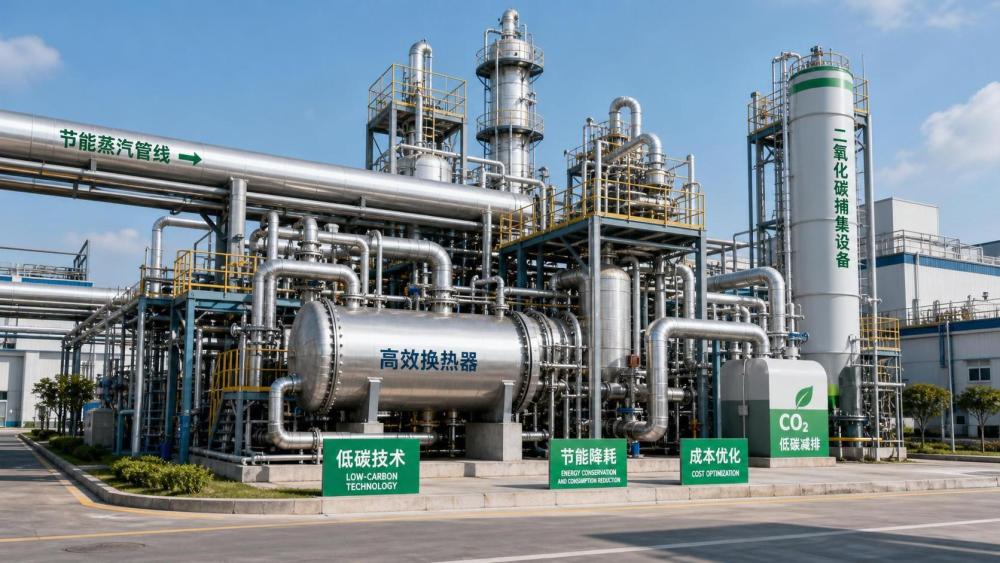
That framing can materially change the result. A high-efficiency exchanger integration project may appear modestly attractive when evaluated as a standalone energy initiative. If it also substitutes for an unavoidable maintenance outage and restores lost heat-transfer performance, its true economic case can be considerably stronger. The same logic applies to electrified drives, advanced process controls, hydrogen recovery, and pressure swing adsorption upgrades where production reliability is part of the benefit.
Energy intensity is often the first source of value—but not the only one
For many chemical facilities, the most defensible low-carbon investments are those that reduce energy use without changing the product or exposing the plant to a new feedstock dependency. Heat recovery, furnace efficiency upgrades, steam-system optimization, compressor modernization, improved insulation, pinch-analysis-based exchanger redesign, and better separation performance can create a direct operating benefit before carbon accounting is considered.
These measures do not automatically qualify as carbon-neutral chemical solutions in a strict lifecycle sense. Their financial strength lies elsewhere: each unit of fuel or electricity avoided reduces operating expenditure and associated emissions simultaneously. This makes the return less dependent on external carbon incentives or customer willingness to pay.
Yet energy savings must be modeled at the system level. Recovering more heat in one section may reduce steam demand but raise pressure drop, complicate fouling management, constrain turndown, or move a bottleneck to another unit. A projected reduction in gigajoules per tonne is not equivalent to a cash saving unless utility balance, operating mode, and production rate support it.
For approval purposes, the savings case should distinguish between:
- avoidable cost: fuel, purchased power, or steam that will genuinely no longer be purchased or generated;
- reallocated cost: energy shifted from one part of the site to another, perhaps with no net reduction in site cost;
- accounting benefit: an emissions reduction that improves reporting but has no immediate cash value;
- contingent value: savings that require a certain production rate, utility price, or operating discipline.
A project whose payback depends on full-load operation deserves additional scrutiny when the underlying facility has variable utilization. Fixed annual savings are frequently overstated when models apply design-capacity energy performance to every operating hour.
Carbon cost has value only when the exposure is real
Carbon pricing, emissions trading systems, border-adjustment mechanisms, and customer reporting requirements can alter chemical project economics, but they should not be inserted into a model as a generic uplift. The value depends on the facility’s jurisdiction, emissions boundary, allocation position, export mix, product classification, and the timing of applicable obligations.
The financially relevant question is narrower: does the project reduce a cost that the business is already paying, reasonably expects to pay under an established rule, or must absorb to keep supplying a defined market? If the answer is yes, the avoided carbon cost can be treated as part of the operating case, subject to the same price and volume sensitivities used elsewhere in capital planning.
If the benefit instead depends on policy changes that are still uncertain, it should be separated from the base case. It may justify a staged investment, pilot, reserved plot space, or equipment specification that preserves future optionality. It should not be used to conceal a weak core return.
This separation matters in coal conversion and high-emission syngas routes. Carbon capture may be technically more straightforward where the process already produces a concentrated CO2 stream, such as certain hydrogen, ammonia, methanol, or gasification-linked configurations. Even then, capture is only one part of the investment. Compression, dehydration, transport, storage or utilization arrangements, monitoring obligations, energy demand, and long-term liability allocation determine whether captured carbon translates into a financial benefit.
A capture unit without a durable outlet for CO2 is not a complete business case. Nor is a utilization route automatically valuable: converting CO2 into a product may simply relocate emissions unless the full process, energy source, product lifetime, and market demand support the claimed reduction.
Feedstock substitution needs a margin test, not a premium narrative
Low-carbon methanol, ammonia, hydrogen, recycled carbon feedstocks, and bio-based intermediates can alter a product’s emissions profile, but their cost structure differs fundamentally from that of conventional fossil-based supply. Their economics are often dominated by the cost and availability of low-carbon electricity, sustainable feedstock, certified attributes, logistics, and supply-contract terms.
The key approval question is whether the new input can be converted into a durable margin improvement or a defensible risk reduction. A purchaser should not assume that a lower-carbon molecule earns a premium simply because it is lower carbon. The premium must be supported by a customer agreement, a tender requirement, a specification, or a market segment where switching costs and traceability requirements have commercial force.
Where no such premium exists, the proposed solution must stand on cost reduction, avoided liability, or strategic supply security. This can still be viable. For example, a substitution may reduce exposure to volatile natural gas, imported feedstocks, or constrained specialty gases. But that benefit must be quantified through realistic contract scenarios rather than described as a general resilience advantage.
Book-and-claim systems, renewable certificates, and mass-balance allocation can support market claims under defined schemes, but they do not remove the need to verify what is being purchased. Financial models should identify whether a claimed lower-carbon attribute is bundled with the physical product, separately certified, transferable, limited by geography, or subject to expiration. A buyer paying for an attribute that cannot be passed through to its own customers is paying a cost, not acquiring margin protection.
Lifecycle cost determines whether the initial premium is recoverable
Capital expenditure is visible; lifecycle cost is where many decisions are won or lost. A lower-emissions process can require a more complex control system, upgraded electrical infrastructure, new storage, additional water treatment, specialist maintenance, or periodic replacement of membranes, sorbents, and catalysts. Those obligations need to be reflected in the same model as the expected energy and carbon savings.
The most useful financial view is an unlevered project cash-flow model that follows the asset through engineering, procurement, construction, commissioning, operation, major maintenance, and end-of-life obligations. The model should not collapse all benefits into a single “sustainability saving” line. Each value source should remain visible so that its owner, timing, and evidence can be challenged.
Discount rate selection also deserves discipline. Assigning a punitive discount rate merely because a project is labeled “new energy” can reject upgrades whose technical components are familiar and whose savings are measurable. The opposite error is equally damaging: using a low strategic hurdle rate for an immature solution with unresolved supply, performance, or permitting dependencies. Risk belongs in the cash flows where it can be examined, and in the discount rate only where it cannot be modeled explicitly.
Integration risk is a financial variable, not an engineering footnote
In continuous chemical operations, the value lost during an extended outage can exceed the anticipated annual benefit of an energy or emissions upgrade. Installation sequence, tie-in windows, utility interruptions, commissioning duration, process safety review, control-system integration, and vendor performance guarantees should therefore influence the approval decision from the beginning.
A retrofit that promises attractive annual savings but requires a long shutdown may still be justified during a planned turnaround. It may be unattractive as a standalone intervention. Timing changes economics. So does modularity: a solution that can be installed in stages, isolated during commissioning, or expanded after performance verification reduces capital at risk.
Guarantees should be examined for their measurement basis. A supplier guarantee tied to ideal feed composition, stable ambient conditions, or a narrow operating envelope may provide little protection in a plant with fluctuating feed quality or frequent turndown. The commercial agreement should define performance tests, correction factors, remedies, availability expectations, and responsibility for interfaces with existing equipment.
What turns a low-carbon proposal into an approvable project
The strongest projects do not rely on a single benefit. They combine an unavoidable asset decision with verifiable operating savings, a clearly bounded emissions exposure, and manageable execution risk. Their assumptions can be traced to utility bills, production records, signed commercial terms, established compliance obligations, or technically credible performance guarantees.
Weak proposals tend to reverse that logic. They start with a broad decarbonization target, apply a favorable carbon-price forecast, assume a customer premium, and treat integration costs as a later engineering detail. Such projects may still be strategically necessary, but they should be funded as capability-building or compliance preparation rather than presented as conventional return investments.
Carbon-neutral chemical solutions are financially rational when they lower the cost of making the same product, protect a defined revenue stream, or avoid a credible future cost while preserving operational reliability. When those conditions are absent, the appropriate response is not necessarily rejection. It may be to reduce scope, secure offtake, align the investment with a turnaround, negotiate risk-sharing, or wait until the missing commercial condition becomes real.