Search
Category
Related Industries
- How slag viscosity affects entrained flow gasifier performanceDiscover how slag viscosity affects entrained flow gasifier drainage, efficiency, and wall durability—and learn what to evaluate for more reliable operation.
- How to assess oversupply risk with olefins market intelligenceUse olefins market intelligence to assess oversupply risk through capacity, demand, costs, and trade flows. Discover how to strengthen procurement and investment decisions.
- How grid bottlenecks shape energy infrastructure investment in EuropeExplore energy infrastructure Europe can rely on: discover how grid bottlenecks, connection risks and storage economics shape investment decisions and project value.
Weekly Insights
Stay ahead with our curated technology reports delivered every Monday.
What does technical audit chemical compliance involve in practice?




What Does Technical Audit Chemical Compliance Involve in Practice?
Technical audit chemical compliance is often misunderstood as a document review: collect safety data sheets, inspect permits, check training records, and close the file. In real chemical operations, that approach is too narrow. A meaningful audit tests whether the plant’s written controls match the chemistry, equipment condition, operating envelope, and actual behavior on site.
For quality and safety managers, the central question is not simply, “Do we have the required procedures?” It is, “Can this process remain within its approved safety, quality, and environmental limits when conditions change?” That includes feedstock variation, catalyst aging, maintenance interventions, abnormal pressure or temperature trends, utility instability, contractor activity, and changes in product specifications.
A practical technical audit chemical compliance program therefore connects compliance obligations with the physical reality of the operation. It examines process controls, hazardous-material management, emissions systems, mechanical integrity, emergency readiness, traceability, and the decision-making process behind deviations. The audit should identify not only a missing record, but also the technical reason why a missing record could become an exposure, release, off-spec batch, injury, or shutdown.
Compliance begins with the operating context, not a generic checklist
Chemical compliance requirements vary by jurisdiction, substance class, plant role, and export market. A site may need to account for local environmental permits, occupational exposure obligations, hazardous-waste rules, transport requirements, chemical inventory controls, and product-specific regulations. Depending on the market, this can involve frameworks such as GHS hazard communication, REACH, TSCA, or other national and regional requirements. None should be treated as automatically applicable without confirming the site’s location, legal entity, products, and supply-chain responsibilities.
The auditor’s first task is to build a usable compliance map. This normally links each obligation to a process area, responsible role, evidence source, review frequency, and escalation path. A permit condition on a flare, for example, belongs not only in an environmental file. It should connect to operating procedures, instrumentation, maintenance history, upset reporting, and production planning. If those links do not exist, the plant may be compliant on paper while lacking control in practice.
This is especially relevant where process units have been modified over time. A new feedstock, debottlenecking project, different catalyst, altered recycle ratio, or added carbon-capture interface can change the assumptions behind previous assessments. Small engineering changes are often treated as routine; in a high-hazard system, they can alter corrosion behavior, relief load assumptions, impurity profiles, or emissions characteristics.
What the audit team verifies on the plant floor
A sound audit moves repeatedly between documents, control-room data, equipment, and interviews. Each source answers a different question. Procedures show intended work. Trend data reveal process behavior. Field inspection shows equipment condition and work practices. Conversations with operators and technicians reveal whether controls are understood, practical, and used during abnormal situations.
The following areas are usually examined together because their risks overlap:
- Chemical inventory and classification: whether the inventory reflects materials actually present, including intermediates, laboratory chemicals, cleaning agents, wastes, samples, and temporary materials. Labels, containers, safety data sheets, and storage segregation should be consistent with the identified hazards.
- Process safety information: whether current process flow diagrams, piping and instrumentation diagrams, operating limits, material compatibility data, and relief-system information are available to the people who need them.
- Operating discipline: whether start-up, shutdown, sampling, line-breaking, isolation, transfer, and emergency procedures describe actual field conditions rather than an idealized process.
- Mechanical integrity: whether inspection, testing, calibration, and maintenance records demonstrate that safety-critical equipment is managed according to the applicable design basis, risk assessment, and site requirements.
- Environmental control: whether monitoring, waste handling, venting, wastewater treatment, spill containment, and emissions-related records align with permit conditions and operating realities.
- Quality control and traceability: whether incoming materials, batches, analytical results, deviations, rework, and release decisions can be traced reliably enough to prevent nonconforming or incorrectly classified materials from moving downstream.
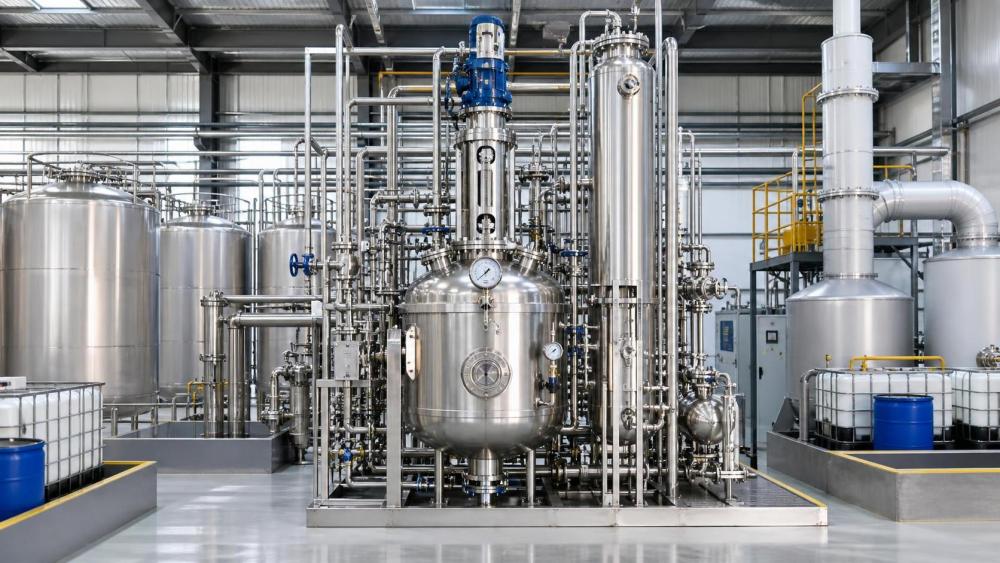
The value lies in testing the connections. An auditor may compare the maximum allowable operating limits in a procedure with distributed control system alarm settings, then review whether alarm bypasses were documented and whether operators understand the required response. A calibration certificate alone does not prove control if the instrument is installed in the wrong location, has an unsuitable range, or is routinely overridden because nuisance alarms have become normal.
Process controls: where compliance becomes engineering
Technical audit chemical compliance becomes most demanding when the process operates near significant thermal, pressure, flammability, toxicity, or corrosion limits. In high-pressure polymerization, hydrocracking, syngas conversion, air separation, or specialty-gas purification, the key concern is rarely one document. It is whether several layers of protection continue to function as a coherent system.
Auditors generally review the relationship between normal operating ranges, alarm thresholds, interlocks, trips, relief devices, and operator intervention. They also look for evidence that deviations are investigated technically. A recurring high-temperature alarm may point to fouling, catalyst condition, poor mixing, exchanger performance, sensor drift, unstable feed composition, or an unrealistic alarm limit. Closing the alert without identifying the mechanism is not a robust corrective action.
For a reactor system, particular attention may be given to pressure containment, materials of construction, corrosion monitoring, quench or cooling availability, agitation or mixing performance, and emergency depressurization logic. For gas purification, impurity breakthrough, adsorbent condition, moisture control, analyzer reliability, and cylinder or bulk-transfer management may carry equal weight. The appropriate depth of review depends on the hazard profile and applicable standards, but the audit should always distinguish between a control that exists and a control that is demonstrably effective.
Change management is a frequent weak point
Many compliance gaps are introduced through change rather than original design. A temporary hose is left in service, an alternative raw material is approved under production pressure, a repair changes a component specification, or a software modification affects a permissive. Individually, these may appear minor. Collectively, they can move the process beyond the assumptions of the hazard review, permit, quality plan, or equipment design basis.
An audit should test the management-of-change process with real samples, including completed and emergency changes. It should ask whether the change was technically reviewed, whether environmental and product implications were considered, whether drawings and procedures were updated, whether affected personnel were trained, and whether the change was formally closed after verification. A change process that produces approvals but leaves outdated field instructions is not complete.
This matters in decarbonization projects as well. Adding carbon capture, hydrogen handling, renewable-feedstock blending, green ammonia integration, or heat-recovery equipment may alter the mass and energy balance of an established unit. Compliance review must examine the interfaces: new contaminants, pressure interactions, off-gas routing, utilities demand, water balance, control-system dependencies, and emergency scenarios. The project can be environmentally positive while still creating a new operational risk if integration is poorly governed.
Environmental evidence must be technically credible
Environmental compliance is often reduced to monitoring reports and waste manifests. Those records matter, but a technical audit asks whether the numbers can be trusted and whether they represent normal and abnormal operating conditions. It may review sampling locations, analyzer maintenance, laboratory methods, chain-of-custody controls, calculation assumptions, abnormal-release logs, and reconciliation between production rates, material consumption, waste generation, and reported emissions.
For large heat-exchanger networks, a loss of thermal performance can have compliance consequences as well as energy consequences. Higher firing demand, altered cooling-water loads, temperature excursions, or increased venting may change the environmental profile of a unit. Similarly, leaks in volatile service, poorly controlled tank breathing, or incompatible waste streams can become visible only when field observations are compared with process records.
The goal is not to assume wrongdoing whenever data are imperfect. It is to establish whether the monitoring system has defined ownership, appropriate maintenance, defensible records, and a clear response when readings are missing, implausible, or outside an allowed condition.
How findings should be prioritized
A long list of observations is not necessarily a useful audit outcome. Findings should be ranked by potential consequence, likelihood or exposure pathway, regulatory significance, and the strength of existing safeguards. A missing signature on a low-risk record and an unreviewed bypass on a safety-critical instrument should not receive the same treatment merely because both are “nonconformities.”
Good reporting explains the evidence, the requirement or internal standard involved, the technical implication, and the corrective-action expectation. It also names a realistic owner. “Improve safety awareness” is weak because it cannot be verified. “Reconcile high-high reactor temperature trip settings against the approved operating envelope; document functional testing and update the operator response procedure” gives the site a testable action.
Corrective actions need closure discipline. Some issues can be addressed immediately through housekeeping, labeling, or record correction. Others require engineering review, shutdown planning, capital work, permit discussion, or an updated hazard assessment. Temporary risk controls may be appropriate, but they should have an owner, expiry date, and formal review. Temporary measures have a tendency to become permanent when no one is required to revisit them.
Using external intelligence without losing site-level judgment
Complex process industries benefit from looking beyond their own fence line. CS-Pulse follows the technical conditions shaping petrochemical plants, coal-based synthesis, industrial gas refining, high-pressure reactors, and large heat-exchanger integration. Its focus on reaction kinetics, thermal-fluid behavior, process optimization, and evolving environmental thresholds reflects an important audit reality: compliance cannot be separated from engineering knowledge.
For example, information on reactor mixing, pressure swing adsorption performance, corrosion-sensitive services, or carbon-capture integration can help an audit team frame sharper questions. Yet external intelligence does not replace the site’s own process hazard information, permit conditions, inspection data, or legal review. It is most useful when it helps teams recognize where assumptions may have changed and where deeper verification is needed.
A practical starting point for quality and safety teams
Before commissioning an audit, define its boundaries clearly: facilities covered, substances and product families involved, relevant markets, applicable permits and standards, recent process changes, and known operating concerns. Assemble current process documents rather than relying on archived versions. Include maintenance, laboratory, warehouse, environmental, production, and contractor-management representatives early; chemical compliance failures commonly occur at the handoff between functions.
The strongest technical audit chemical compliance review is not the one that produces the most findings. It is the one that gives the site a defensible view of its real control condition and a prioritized route to improve it. When audit evidence, operating data, and field practice tell the same story, managers can be more confident that compliance is embedded in the process—not stored in a binder.