Search
Category
Related Industries
- How slag viscosity affects entrained flow gasifier performanceDiscover how slag viscosity affects entrained flow gasifier drainage, efficiency, and wall durability—and learn what to evaluate for more reliable operation.
- How to assess oversupply risk with olefins market intelligenceUse olefins market intelligence to assess oversupply risk through capacity, demand, costs, and trade flows. Discover how to strengthen procurement and investment decisions.
- How grid bottlenecks shape energy infrastructure investment in EuropeExplore energy infrastructure Europe can rely on: discover how grid bottlenecks, connection risks and storage economics shape investment decisions and project value.
Weekly Insights
Stay ahead with our curated technology reports delivered every Monday.
What evidence does carbon reduction for chemicals certification require?




Certification Starts With a Verifiable Product Carbon Claim
For chemical manufacturers, carbon reduction for chemicals certification is rarely achieved by presenting a lower utility bill, a renewable-power contract, or a statement that a new process is more efficient. Certification bodies need evidence that connects a defined chemical product to a defined carbon-accounting method, a stated baseline or comparator, and records that can be independently traced.
The first practical question is therefore not “How much have we reduced?” It is “What exactly is being certified?” A site-level greenhouse-gas inventory, a product carbon footprint, a mass-balanced low-carbon feedstock claim, and a verified emissions-reduction project can all require different evidence. Teams that assemble documents before settling this scope often find that their data are accurate but unusable for the selected certification route.
For quality-control and safety managers, the work sits at the intersection of metrology, process control, document governance, and change management. The most persuasive dossier is one in which every reported emissions figure can be followed back through meters, laboratory records, production logs, feedstock specifications, allocation rules, and controlled calculations without relying on informal explanations.
Define the Product, Boundary, and Claim Before Collecting Data
A certification review needs a stable unit of assessment. In chemicals, this may be one tonne of methanol, ammonia, ethylene, purified hydrogen, specialty gas, polymer resin, or an intermediate delivered at a specified purity and pressure. The product specification matters. A claim for one tonne of high-purity gas cannot automatically use the energy profile of a broader gas stream if purification, compression, cylinder filling, or losses are material to the final product.
The assessment boundary must also be explicit. Depending on the scheme and the customer claim, it may cover only direct emissions at the manufacturing site, purchased electricity and steam, upstream feedstocks, transportation, packaging, use phase, or end-of-life treatment. “Cradle-to-gate” and “gate-to-gate” are not interchangeable descriptions. A reduction reported inside a plant fence may be real, but it does not by itself prove that the product has a lower full life-cycle footprint.
Auditors will usually test whether the claimed result uses a consistent functional unit and comparison basis. For example, an intensity reduction per tonne of product can be distorted if annual throughput fell, product grade changed, or off-spec output was excluded. A fair comparison normally requires documented equivalence in product quality, accounting boundary, allocation method, and relevant operating conditions.
Where a business uses an internal reference year or a conventional product comparator, preserve the evidence supporting that choice. The baseline should not be selected only because it produces a favorable percentage reduction. It needs a technical rationale, a defined data period, and records showing why the historical process or comparator represents a legitimate reference.
The Evidence Package Auditors Commonly Expect
Although detailed requirements vary by certification program, a robust evidence package usually has four connected layers: a calculation model, primary operational data, traceability records, and management controls. Each layer must support the others. A polished life-cycle assessment report is weak if the underlying energy meters are not linked to the assessed line, while complete meter readings are insufficient if the allocation method is undocumented.
1. A documented carbon-accounting method
The calculation file should state the standard or methodology used, the assessment period, organizational and product boundaries, emission factors, data sources, assumptions, exclusions, allocation rules, and treatment of co-products, recycled materials, captured carbon, and waste. It should show equations clearly enough for a reviewer to reproduce the result.
Chemical production often makes allocation the most consequential methodological issue. Steam, hydrogen, oxygen, nitrogen, synthesis gas, olefins, aromatics, and multiple downstream grades may share utilities or process units. Assigning emissions to products by mass, energy content, economic value, system expansion, or another rule can materially change the reported footprint. The chosen method should follow the applicable scheme and be used consistently. Changing it between periods requires documented justification and, where required, recalculation of the comparison period.
Emission factors also require control. Electricity factors, fuel factors, upstream feedstock factors, and transport factors should be versioned and identifiable. A calculation may become non-comparable when factors are replaced without recording their source, geography, time basis, or reason for use.
2. Primary evidence for energy and process emissions
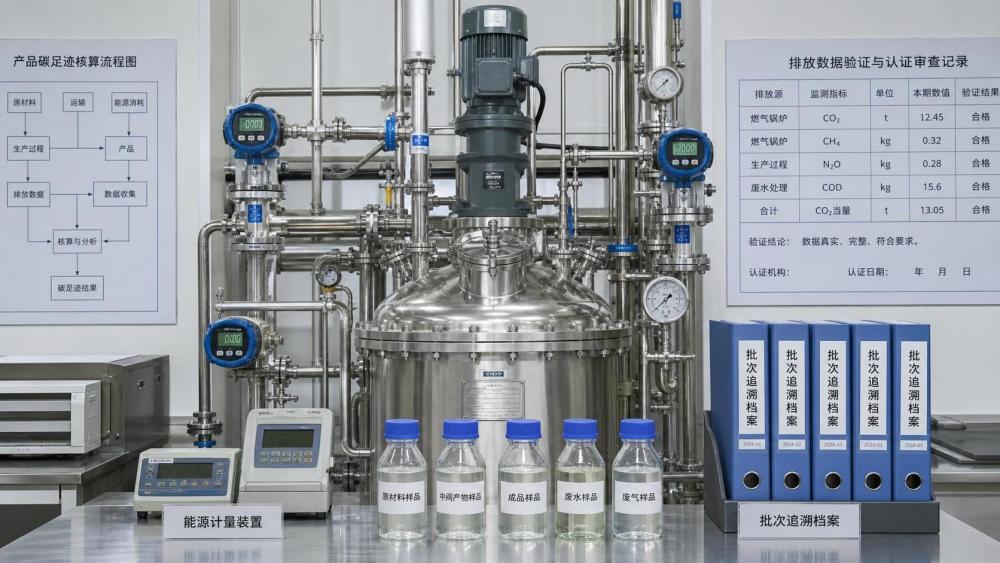
Certification relies heavily on records generated at the point of operation. Relevant evidence can include fuel purchase records, gas chromatograph results, fuel-gas composition data, flowmeter readings, utility invoices, electricity meter exports, steam balances, flare records, stack monitoring records, refrigerant records, and maintenance certificates for critical instruments.
For a steam cracker, reformer, gasifier, or high-pressure synthesis loop, the dossier should explain how energy consumption and emissions are assigned to the assessed product rather than merely reporting site totals. For an industrial-gas purification train, that may mean separating the electricity used by compression, pressure swing adsorption, cryogenic separation, and product handling. For heat-integration projects, evidence should distinguish an actual reduction in external fuel demand from a heat duty that has simply been transferred elsewhere in the process.
Meter quality is a common audit pressure point. Teams should retain meter identification, calibration status, reading frequency, data ownership, reconciliation procedures, and treatment of missing values. A monthly utility invoice may validate a facility total, but it cannot independently substantiate a product-line claim unless there is a defensible energy allocation.
3. Feedstock origin, composition, and chain-of-custody records
Feedstock evidence becomes especially important when a carbon claim depends on renewable, recycled, circular, bio-based, low-carbon, or captured-carbon inputs. Purchase contracts alone may not prove the attributes assigned to the delivered material. The certification file may need supplier declarations, certificates, bills of lading, batch or lot identifiers, receiving records, mass-balance ledgers, inventory reconciliation, and evidence that claimed volumes do not exceed eligible input volumes.
Mass balance should be treated as an accounting control, not as a marketing shortcut. If certified and conventional feedstocks enter the same storage system or process network, the organization needs a documented rule for assigning the certified attribute to outgoing product. The ledger must reconcile opening stock, incoming certified quantity, production, sales, losses, transfers, and closing stock over the required period. Any conversion factor, yield loss, or downgrade must be visible.
Laboratory data may also be necessary, particularly where feedstock composition affects process emissions or product specification. Quality-control teams should be able to show sampling plans, analytical methods, calibration records, chain of custody for samples, and release criteria. These controls serve both product quality and carbon-accounting integrity.
4. Production, yield, and material-balance evidence
Reported carbon intensity depends on the denominator as much as the emissions numerator. Production records should identify the quantity of conforming product produced during the assessment period, treatment of rework and off-spec material, inventory changes, and conversion losses. Batch records, distributed control system data, production reports, tank measurements, warehouse records, and shipping documents may all be relevant.
A complete mass balance is particularly valuable in multi-output chemical systems. It helps reviewers identify whether feedstock, intermediates, by-products, waste, and saleable products reconcile with the process model. Large unexplained differences may point to weak data capture, inconsistent units, unrecorded stock changes, or incorrect emissions allocation.
Evidence for Reduction Measures Must Show Causality
A lower calculated footprint does not automatically demonstrate that a specific carbon-reduction initiative caused the result. Where certification concerns an emissions-reduction project or a reduction claim against a baseline, reviewers commonly expect evidence of the intervention itself and proof that its impact has not been counted twice.
For a furnace revamp, heat exchanger retrofit, catalyst change, variable-speed compressor installation, electrified heating system, carbon-capture unit, or PSA optimization, retain the approved engineering scope, commissioning documentation, design basis, operating envelopes, control narratives, and performance records. Pre- and post-change data should be comparable. A reduction attributed to improved heat recovery, for instance, should account for throughput, feed quality, ambient conditions, product mix, and any change in export steam or imported power.
Carbon capture requires particularly careful documentation. The evidence should identify the capture point, measured quantity, purity where relevant, energy penalty, compression and transport emissions, storage or utilization route, and contractual or physical controls over the captured stream. Captured carbon should not be treated as permanently removed merely because it leaves the process boundary. The claimed treatment depends on the methodology and the fate of that carbon.
Renewable electricity claims similarly need more than a corporate procurement statement. The applicable program may specify whether contractual instruments, direct supply arrangements, residual-mix factors, market boundaries, and cancellation records are accepted. Quality teams should confirm that the evidence matches the geography, time period, and consumption volume used in the footprint calculation.
Management-System Evidence Often Determines Audit Readiness
Third-party review is not limited to emissions arithmetic. Auditors need confidence that the organization can produce the same type of result reliably after the certificate is issued. That is why controlled procedures, responsibilities, training records, internal checks, and corrective-action records matter.
A useful control framework assigns ownership for metering, production data, purchasing data, laboratory data, carbon calculations, document approval, and customer-facing claims. It also defines how changes are assessed. A new feedstock supplier, modified reactor severity, different utility contract, outage, meter replacement, or change in co-product disposition can affect certification status. Without a formal change-control process, a previously valid model can drift away from plant reality.
Common Evidence Gaps in Chemical Operations
The most frequent weakness is relying on plant-wide emissions data for a product-level claim. Site inventories are important, but chemical complexes often contain shared utilities, integrated production units, and multiple co-products. The missing link is usually a transparent allocation model supported by operational records.
Another issue is treating engineering estimates as permanent evidence. Design simulations and nameplate efficiency can support a technical narrative, especially before commissioning, but certification generally needs evidence of actual operating performance over the required period. Engineering calculations should be reconciled with measured fuel, electricity, throughput, and yield data.
Teams also underestimate the effect of routine operational events. Startup fuel, shutdowns, flaring, maintenance bypasses, steam imports, emergency power, product disposal, and off-spec campaigns may be excluded or averaged away without justification. A sound method states how such events are handled and applies that treatment consistently.
Finally, a certificate does not authorize broad claims beyond its scope. A product-level carbon result does not necessarily establish a net-zero facility, a carbon-neutral supply chain, or permanent removal of emissions. Marketing, sales, and procurement communications should use language that matches the certified boundary, product, period, and methodology.
How Quality and Safety Teams Can Prepare Efficiently
Start with a data walk-through of one representative product and one reporting period. Trace the product from incoming feedstock to shipment, then trace every significant emissions input back to its source record. This approach exposes gaps earlier than asking each department for generic sustainability data.
- Confirm the exact claim, product specification, functional unit, and certification boundary.
- Map feedstock, utilities, process steps, co-products, wastes, and shipment points against available records.
- Identify shared assets and approve the allocation approach before final calculations are issued.
- Check calibration and reconciliation status for the meters that drive the result.
- Build a controlled evidence index linking each calculation input to a record owner and document version.
- Establish triggers for reassessment after material process, feedstock, utility, or product-mix changes.
The strongest certification submission is not the one with the largest document volume. It is the one where the carbon claim, physical process, quality records, and management controls tell the same story. For chemical operations handling complex reactions, shared energy systems, and tightly specified products, that discipline is what turns a reduction claim into evidence that can withstand scrutiny.