
Search
Category
Related Industries
- How slag viscosity affects entrained flow gasifier performanceDiscover how slag viscosity affects entrained flow gasifier drainage, efficiency, and wall durability—and learn what to evaluate for more reliable operation.
- How to assess oversupply risk with olefins market intelligenceUse olefins market intelligence to assess oversupply risk through capacity, demand, costs, and trade flows. Discover how to strengthen procurement and investment decisions.
- How grid bottlenecks shape energy infrastructure investment in EuropeExplore energy infrastructure Europe can rely on: discover how grid bottlenecks, connection risks and storage economics shape investment decisions and project value.
Weekly Insights
Stay ahead with our curated technology reports delivered every Monday.
Process Plant Modernization Roadmap for Aging Automation and Utilities




Modernization should begin where an aging plant is most exposed, not where new technology looks most impressive. In a chemical, petrochemical, industrial-gas, or energy facility, that usually means the control layers and utility systems that quietly determine whether production remains stable: obsolete controllers, unsupported operator workstations, incomplete instrumentation records, unreliable steam or power balances, and weak separation between operational technology and business networks.
A credible process plant modernization roadmap treats these conditions as connected operational risks. Replacing a distributed control system without addressing field-device health, alarm quality, utility constraints, maintenance workflows, or cybersecurity can produce a newer interface without producing a more resilient plant. The market is moving toward staged programs that protect production continuity while creating a reliable data foundation for efficiency, emissions management, and future process changes.
The modernization market is shifting from replacement projects to resilience programs
For years, many modernization projects were triggered by a clear event: a vendor announced end-of-support for a controller family, spare parts became difficult to source, or a major turnaround created an opportunity to replace equipment. Those triggers still matter. What has changed is the scope of the decision.
Plants are now expected to operate safely with longer asset lives, manage tighter energy margins, accommodate changing feedstocks or product specifications, and provide more reliable operational information to management teams. In parallel, digital connectivity has expanded the value of production data but also enlarged the cyber exposure of control environments. A plant that can no longer patch critical systems, validate its instrument inventory, or reconstruct the logic behind key interlocks is carrying a strategic liability, not merely an engineering inconvenience.
This does not mean every legacy asset requires immediate replacement. Some older systems remain technically sound, well documented, and isolated from external connectivity. Others may be old but still maintainable because trained personnel, tested spares, and a clear migration path are available. The priority is determined by the consequences of failure and the feasibility of recovery, not by age alone.
The strongest modernization programs therefore combine three questions: What could interrupt safe production? What is consuming excessive energy or maintenance effort? And what prevents the plant from making informed decisions quickly? The overlap between those questions identifies the work that deserves early capital.
Build the roadmap around operational exposure
Before selecting automation platforms or approving a capital package, create a practical baseline across the plant. This is more useful than beginning with a broad promise of “digital transformation,” because it reveals where technical debt is concentrated and where a phased investment can produce measurable operational value.
A useful baseline should cover the control architecture, field instrumentation, utility networks, electrical interfaces, historian and data quality, safety functions, documentation, spares, and vendor support status. It should also identify which units cannot tolerate an unplanned trip, which shutdown windows are realistic, and which process changes are already under consideration.
The assessment should distinguish between a component’s condition and its business impact. A deteriorating instrument on a noncritical utility branch may be manageable. The same condition on reactor pressure control, hydrogen purification, furnace firing, or an emergency shutdown boundary deserves a different response. This distinction prevents scarce capital from being absorbed by a long list of low-consequence replacements.
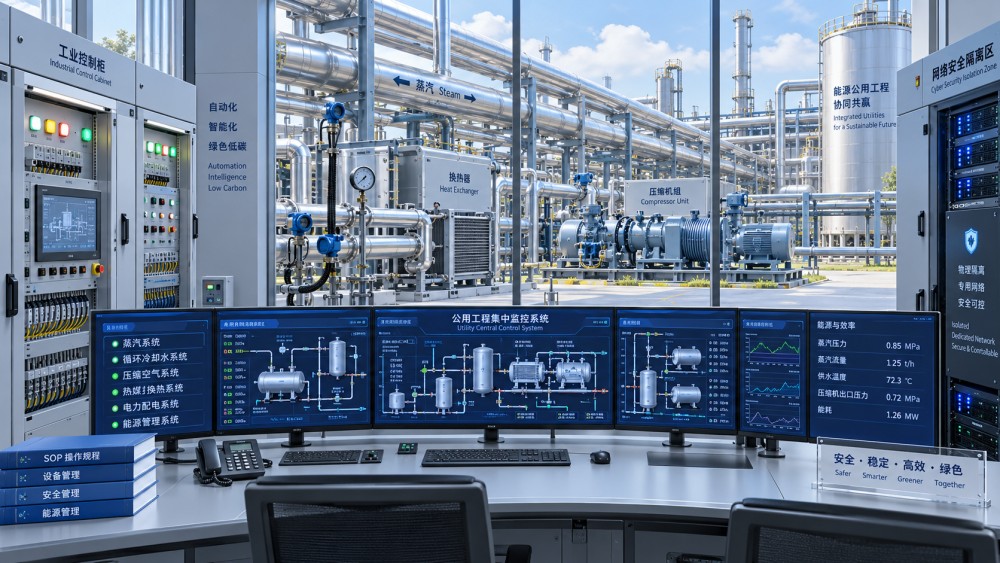
Automation modernization is not a “rip and replace” decision
The most difficult decision is often whether to migrate an entire control environment at once or use a phased approach. Full replacement can be justified when the platform has reached an unacceptable support condition, hardware failures are recurring, the architecture cannot be secured appropriately, or the plant is already planning a substantial process redesign. It can also simplify long-term support by eliminating multiple generations of controllers and engineering tools.
However, a full replacement compresses technical, operational, and commissioning risk into a short shutdown period. It demands accurate loop records, tested logic conversion, disciplined factory acceptance testing, trained operators, and realistic contingency planning. Plants that underestimate these prerequisites may face startup delays or a prolonged period of unstable control after commissioning.
Phased migration is often better when production continuity is the overriding constraint. A site may first replace workstations and servers, establish a secure historian and backup environment, migrate one process area during a planned turnaround, then address remaining units as shutdown opportunities arise. This approach spreads capital and reduces outage exposure, but it requires strong interface management. Temporary gateways, mixed controller generations, and duplicated engineering environments can become a permanent source of complexity if the end-state architecture is not defined from the beginning.
Start with architecture, not screens
New operator graphics are valuable when they improve situational awareness, but they should not lead the program. The architecture must first establish clear boundaries between basic process control, safety functions, plant information systems, remote support, and corporate networks. Backup and recovery procedures should be proven, not simply documented. Alarm rationalization should be addressed before a new interface reproduces years of nuisance alarms in a more modern format.
The same principle applies to advanced process control and machine-learning applications. These tools can improve control performance when the underlying measurements are reliable, process constraints are understood, and operators trust the recommendations. They are poor substitutes for faulty transmitters, unstable utility supply, or incomplete operating discipline. Modernization should create the conditions under which advanced tools can work, rather than purchasing analytics to compensate for weak fundamentals.
Utilities deserve equal status with the production units
Utilities are often treated as supporting infrastructure until they become the reason a production unit must reduce rate or shut down. Steam, fuel gas, electricity, cooling water, refrigeration, compressed air, nitrogen, hydrogen, and water treatment affect product quality, equipment integrity, and energy cost across the site. Their performance also shapes the practical value of process upgrades.
For example, a new furnace optimization system will have limited benefit if steam headers are unstable or heat-recovery equipment is fouled and poorly monitored. A compressor-control upgrade may improve reliability, but the result will be constrained if air leaks, pressure setpoints, and demand peaks are not managed across the network. In high-purity gas operations, weak analyzer reliability or inconsistent purification control can affect downstream users even when the main production equipment is functioning normally.
Utility integration should therefore be included in the first modernization wave when it constrains throughput, safety margins, or energy performance. This does not always require a major central project. It may begin with better metering, verified mass and energy balances, upgraded controls at utility bottlenecks, and common operating visibility across production and utility teams.
Heat integration deserves particular attention in large petrochemical plants, coal-conversion facilities, and high-temperature process units. Heat exchangers are not isolated pieces of equipment; they connect furnace duty, steam generation, cooling demand, separation performance, and emissions intensity. Better monitoring of exchanger condition, bypass behavior, and utility demand can expose losses that are otherwise hidden in aggregate energy data. Where carbon-capture integration, green ammonia, methanol production, or major feedstock shifts are being considered, utility capacity should be tested early because these projects can change steam, power, cooling, and compression requirements across the entire site.
Cybersecurity has become a design requirement
Modernization increases connectivity, and connectivity must be designed with operational safety in mind. A control system should not inherit the access assumptions of a corporate IT environment. Production assets require defined zones, controlled pathways between systems, managed remote access, asset inventories, secure configuration practices, and recovery plans that recognize the realities of continuous operations.
A common mistake is to purchase security tools late in the project, after network design and vendor access arrangements have already been set. By that point, the organization may be trying to protect an architecture that was never designed to be operated securely. Cybersecurity belongs in the front-end engineering decisions: who needs access, what data needs to leave the control zone, how contractors connect, how systems are patched, and how the plant returns to a known state after an incident.
The objective is not maximum isolation at any cost. Operators, maintenance teams, and process engineers need timely information. The objective is controlled connectivity that supports work without exposing critical control functions to unnecessary pathways.
How to sequence capital without losing the operating case
A modernization roadmap should have a target architecture, but its funding should be organized into decision-sized packages. Each package needs a clear reason to proceed: reducing an unacceptable failure exposure, removing a supportability constraint, enabling a planned expansion, resolving a utility bottleneck, or creating the data and cyber foundation for subsequent work.
The best packages are technically coherent. Replacing servers without addressing obsolete network equipment may merely relocate the problem. Installing new flow meters without correcting tag ownership, calibration practices, and historian configuration may add data without adding usable information. Conversely, attempting to solve controls, utilities, electrification, cybersecurity, and enterprise analytics in one capital request often makes the business case hard to govern and harder to execute.
- Define the future operating architecture and migration rules before approving individual projects.
- Rank assets by safety consequence, production impact, recoverability, supportability, and shutdown opportunity.
- Reserve detailed engineering time for documentation cleanup, logic validation, and operator involvement.
- Use planned turnarounds for work that truly requires isolation; avoid forcing unnecessary scope into a limited outage window.
- Track post-project outcomes through reliability, alarm performance, utility stability, maintenance burden, and quality of operating data.
Operator and maintainer participation is especially important. They understand the workarounds that drawings rarely capture: a manual valve used during unstable feed periods, a compressor that trips under a specific weather condition, an analyzer that operators no longer trust, or an alarm that is routinely acknowledged because it has no actionable meaning. Those details should shape design decisions before commissioning, not become defects discovered after startup.
Market intelligence matters when technology choices affect process strategy
Modernization choices are increasingly tied to wider process decisions. Refinery and petrochemical operators may need flexibility for changing feedstock economics. Coal-based synthesis facilities may be evaluating cleaner conversion routes or carbon-management integration. Industrial-gas plants must protect purity, compression reliability, and energy intensity. High-pressure reactors and large heat-exchanger networks require automation changes that respect tight safety margins and complex thermal interactions.
That is where sector-specific intelligence can improve capital sequencing. CS-Pulse follows the relationship between process engineering, reaction kinetics, heat integration, gas purification, and global decarbonization strategy across these asset classes. For project sponsors, the useful question is not whether a trend is prominent, but whether it changes the technical assumptions behind the plant’s next investment: future utility demand, feedstock flexibility, purification requirements, heat-recovery potential, or the control capability needed to run a modified process safely.
Aging plants do not become competitive by accumulating digital components. They become more durable when automation, utilities, people, and investment timing are aligned around the operating risks that matter most. The next practical step is to establish a cross-functional asset baseline, identify the few constraints with the greatest safety and production consequences, and build the modernization sequence around those realities.