Search
Category
Related Industries
- NBS Releases Mid-October 2026 Price Changes for Key Production MaterialsExplore reported NBS mid-October 2026 production material price changes and what mixed trends mean for procurement. Review key data limits before updating supplier quotes and cost assumptions.
- How LOPA hazard analysis assesses runaway risk in hydrogenationLOPA hazard analysis reveals hydrogenation runaway risks. Learn how reaction data, independent safeguards, and response times help validate protection and uncover safety gaps.
- Tsinghua Team Converts Methanol Selectively to Formaldehyde, Co-Producing Green HydrogenMethanol-to-formaldehyde conversion by Tsinghua researchers co-produces hydrogen under mild conditions. Explore the catalyst advance and evidence needed to assess green hydrogen claims.
Weekly Insights
Stay ahead with our curated technology reports delivered every Monday.
Is Energy Transition Driving Demand for Pressure Vessel Alloys?




Is Energy Transition Driving Demand for Pressure Vessel Alloys?
Yes—but not in the simplistic sense that every low-carbon project automatically requires an exotic alloy. The energy transition is changing where pressure vessels are installed, what they contain, and how they are expected to operate over decades. Green hydrogen, carbon capture, ammonia, methanol, industrial gas purification, hydroprocessing, and coal-to-chemicals upgrades all place different combinations of pressure, temperature, cycling, purity requirements, and corrosive contaminants on equipment.
That shift is making material selection more consequential. Carbon steel still has a large place in pressure equipment. It remains economical, familiar to fabricators, and suitable for many clean or moderately demanding services. Yet in a growing number of projects, the vessel material can no longer be chosen mainly from a standard material list. The right alloy must be tied to the actual process envelope: feed composition, water content, impurity profile, upset conditions, weldability, inspection access, design life, and the governing pressure-vessel code.
For EPC contractors and plant owners, the practical question is not merely, “Which alloy is strongest?” It is: “Which material system will remain safe, fabricable, inspectable, and economically defensible in this specific duty?” That is where energy-transition projects are driving demand for more specialized pressure vessel alloys—and for better engineering judgment around them.
Why the transition changes the materials conversation
Traditional refining and petrochemical plants already operate with difficult services: hydrogen, wet sour gas, chlorides, high-temperature hydrocarbons, caustic streams, and cyclic thermal loads are nothing new. What is changing is the mix of process conditions. Decarbonization projects often connect new units to older assets, introduce variable power-driven operation, and handle streams whose impurity content is less predictable during early project development.
A carbon-capture train is a good example. Captured CO2 may appear straightforward on a block-flow diagram, but the corrosion risk depends heavily on water management and contaminants. Dry CO2 behaves very differently from wet CO2. Trace oxygen, sulfur-bearing compounds, chlorides, amines, or degradation products can alter the selection logic for absorbers, separators, compressors, dehydration vessels, and transport systems. The vessel wall is not responding to a project label such as “CCUS”; it is responding to the chemistry actually present at the metal surface.
The same principle applies to low-carbon hydrogen. Hydrogen production, compression, storage, purification, and downstream use can introduce concerns about hydrogen-assisted damage, permeation, embrittlement susceptibility, fatigue, and weld quality. These concerns are not identical across all steels or all operating conditions. A material acceptable in one hydrogen-containing service may be unsuitable in another, particularly when pressure cycling, hardness, residual stress, or contamination are involved.
In other words, the energy transition is not creating one universal “green alloy.” It is widening the number of services where metallurgical discipline matters.
Which emerging applications are pushing alloy demand?
Several process areas are drawing more attention to alloy selection, although the final decision still depends on detailed design conditions and applicable standards.
Hydrogen production, compression, and conversion
Green hydrogen projects bring together electrolyzers, dryers, separators, compression trains, storage systems, and often ammonia, methanol, or synthetic-fuel synthesis downstream. The pressure vessel issue may not sit inside the electrolyzer itself; it often appears around gas handling, high-pressure buffering, purification, and conversion loops.
For high-pressure hydrogen equipment, strength alone is not enough. Engineers need to consider material cleanliness, fracture behavior, cyclic loading, weld procedures, hardness control, and the possibility of hydrogen-related degradation. Depending on the duty, carbon and low-alloy steels, stainless steels, nickel-containing alloys, or clad constructions may each be considered. There is no responsible shortcut from “hydrogen” to a single grade recommendation.
CO2 capture, dehydration, and transport-linked systems
Carbon capture commonly adds equipment to facilities that were not originally designed around concentrated CO2 handling. Absorber-related systems, solvent regeneration sections, knock-out drums, dehydration vessels, compression interstages, and purification equipment can all have distinct corrosion conditions. An amine unit may demand attention to solvent degradation products and heat-stable salts; a compressed CO2 system may make water specification and impurity control the decisive factors.
This is one reason material selection cannot be left until late procurement. A vague statement such as “CO2-resistant material” tells a fabricator almost nothing. The process team must define normal, start-up, shutdown, regeneration, and upset conditions. If that work is incomplete, alloy upgrades can become an expensive reaction to uncertainty rather than a targeted risk control.
Green ammonia and low-carbon methanol
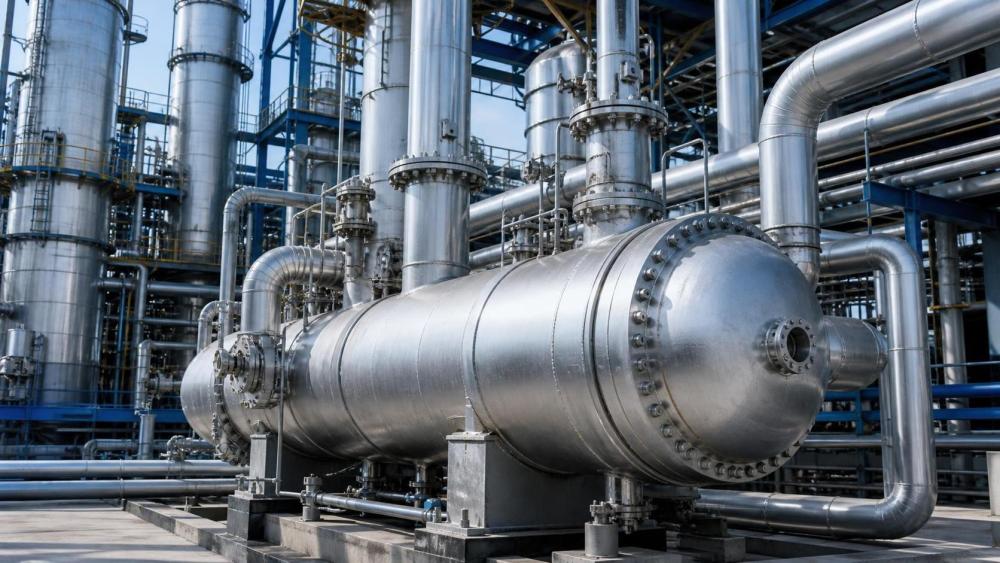
Ammonia and methanol are increasingly discussed as energy carriers and chemical intermediates, but their production routes still rely on demanding synthesis, separation, storage, and heat-integration systems. High pressure, elevated temperature, hydrogen-rich atmospheres, condensate behavior, and catalyst-protection requirements all shape the material decision.
In these facilities, pressure vessel alloys are often part of a broader reliability picture that includes exchanger metallurgy, piping specification, valves, linings, insulation interfaces, and weld inspection. Choosing a premium vessel alloy while overlooking a vulnerable nozzle, transition weld, or connected heat-exchanger channel can simply move the weak point elsewhere.
Refinery retrofits and deep energy conversion
Energy transition investment does not mean conventional processing disappears. Many sites are adapting existing refineries, gas-processing plants, and coal chemical facilities to improve feed flexibility, recover more heat, reduce emissions, add hydrogen capacity, or integrate carbon capture. These retrofits can be more difficult than greenfield construction because new process conditions must coexist with legacy equipment and unknown remaining life.
A hydroprocessing reactor, synthesis loop separator, gasification-associated vessel, or high-pressure purification unit may already have a carefully engineered material system. Any change in feedstock, hydrogen partial pressure, contaminants, temperature profile, or operating cycle should trigger a reassessment. “The vessel has operated for years” is useful history, but it is not proof that it remains suitable for a new duty.
What alloys are receiving more attention?
Demand is rising for materials that can address particular combinations of corrosion resistance, high-temperature performance, toughness, and hydrogen-service suitability. In practice, the conversation often involves carbon steel, low-alloy chromium-molybdenum steels, austenitic stainless steels, duplex stainless steels, nickel alloys, titanium in selected corrosive duties, and clad or weld-overlay solutions.
Clad construction deserves special mention because it often reflects a realistic engineering compromise. A pressure-retaining base material can provide structural strength and cost control, while a corrosion-resistant layer protects the wetted surface. This can be attractive for large reactors, separators, and vessels where solid-alloy construction would be difficult to justify commercially. But clad equipment is not automatically the low-risk option. Bond integrity, overlay quality, nozzle details, repair procedures, differential thermal expansion, and inspection capability all need early attention.
The table is intentionally broad. Specific alloy grades should be selected only after reviewing the full process chemistry, design pressure and temperature, corrosion mechanisms, fabrication route, and code requirements. Material names alone do not substitute for a corrosion study or mechanical design review.
Why variable operation can matter as much as chemistry
The transition also introduces a less obvious issue: operational variability. Renewable-powered hydrogen systems may ramp with electricity availability. Carbon-capture units may follow host-plant loads. Integrated chemical complexes may experience more frequent starts, stops, or turndown events as operators optimize energy use and emissions performance.
That makes thermal fatigue, pressure cycling, local stress concentration, and transient temperature gradients more relevant than they may have been in steady base-load service. A vessel that is chemically compatible may still face a shortened life if its design did not properly account for repeated cycles. Nozzles, supports, internals, welds, and thick-wall transitions deserve the same attention as shell material.
This is where process engineering and mechanical integrity teams need to work closely. The metallurgy team cannot evaluate a material properly if it receives only a single “normal operating condition” and not the credible operating envelope. Equally, a process model should not treat vessel metallurgy as an afterthought once the flowsheet is fixed.
Common mistakes in pressure vessel alloy selection
The first mistake is over-specification. A costly alloy can appear to be the safest answer, yet it may create procurement pressure, fabrication complexity, difficult repairs, or compatibility issues with connected components. The goal is not maximum alloy content. It is an appropriate margin against known damage mechanisms.
The opposite mistake is relying on a generic corrosion allowance when the mechanism is localized corrosion, cracking, or hydrogen-related damage. Extra wall thickness does not solve every problem. If failure can initiate at a weld, crevice, heat-affected zone, or under-deposit location, material grade and fabrication controls become central.
Another recurring problem is treating feed purity as a commercial assumption rather than a design input. In specialty gas refining, PSA systems, hydrogen purification, and CO2 conditioning, trace constituents can determine whether a vessel remains benign or becomes corrosive. Contractual feed specifications, analytical methods, sampling points, and contingency plans should be aligned before material selection is frozen.
A better decision path for EPCs and plant owners
A practical alloy decision usually begins with a service-by-service damage review, not a plant-wide preference for one material family. Define the media, including water and expected impurities. Map temperatures and pressures during normal operation, start-up, shutdown, regeneration, and upset scenarios. Identify relevant corrosion, cracking, fatigue, erosion, and high-temperature damage mechanisms. Then evaluate candidate materials alongside fabrication capability, inspection plans, repair philosophy, lead time, and lifecycle cost.
The governing design and inspection framework must also be clear. Pressure vessel codes, client specifications, jurisdictional rules, and recognized industry practices do not always align neatly across international projects. A material acceptable in principle may still require documented qualification of welding consumables, post-weld heat treatment, non-destructive examination, impact testing, or corrosion testing. These requirements can affect both schedule and risk more than a preliminary material price comparison suggests.
For large process projects, intelligence gathering is part of the engineering work. Teams tracking petrochemical process changes, coal chemical conversion routes, industrial gas refining, high-pressure reactor design, and heat-exchanger integration need to connect market trends with physical operating conditions. That is the value of a process-focused intelligence perspective such as CS-Pulse: not simply noting that green ammonia or carbon capture is expanding, but examining how reaction kinetics, fluid behavior, purification steps, heat recovery, and equipment metallurgy interact in a real plant configuration.
The short answer: demand is becoming more selective
So, is energy transition driving demand for specific pressure vessel alloys? Yes, particularly where hydrogen, wet or impure CO2, high-pressure synthesis, corrosive solvents, thermal cycling, and retrofit constraints overlap. But the trend is toward selective specification rather than blanket substitution of conventional steel with premium alloys.
The strongest projects will be the ones that connect material selection to credible process data early enough to influence equipment design, not just procurement. Before approving an alloy upgrade—or ruling one out—confirm the real operating envelope, impurity assumptions, cycling profile, fabrication route, and inspection strategy. In pressure equipment, a material decision is rarely just a materials decision; it is a statement about how well the project understands its own process.
- energy transition
- petrochemical plants
- coal chemical conversion
- industrial gas refining
- reaction kinetics
- industrial gas purification
- hydroprocessing reactor
- specialty gas refining
- hydrogen purification
- process engineering
- gas purification
- carbon capture
- green ammonia
- pressure vessels
- hydrogen production
- reactor design
- gas refining
- Is energy transition driving demand for specific pressure vessel alloys