
Search
Category
Related Industries
- When should you hire a reaction engineering consultant?When should you hire a reaction engineering consultant? Discover the key decision points for scale-up, safety, design reviews, and troubleshooting.
- Pupuk Kaltim Licenses Topsoe Technology for Low-Carbon Ammonia ProjectPupuk Kaltim licenses Topsoe’s SynCOR Ammonia technology for its planned Fakfak complex. Discover how the project aims to reduce gas use and emissions.
- How does coal quality affect gasifier selection in Southeast Asia?Choosing coal gasification systems Southeast Asia projects can rely on? Explore how moisture, ash and reactivity shape gasifier selection and plant performance.
Weekly Insights
Stay ahead with our curated technology reports delivered every Monday.
Is Quantum Encryption Practical for Energy Plant Control Systems?




Quantum-resistant protection is practical for selected energy plant communications, but quantum key distribution is rarely the first upgrade to make. In a petrochemical complex, gas refining facility, or power plant, adding security must not disrupt controller timing, operator visibility, or safe shutdown functions. Post-quantum cryptography generally offers a more deployable migration path than installing dedicated quantum communication equipment.
Is quantum encryption practical for protecting energy plant control systems? Yes, at carefully chosen boundaries—not as a blanket replacement for existing industrial security. A connection between a plant and a remote control center may justify quantum-resistant protection. A legacy controller network running time-sensitive equipment needs a different approach, usually involving segmentation, supported gateways, and preservation of validated control behavior.
What does “quantum encryption” actually mean for a plant?
The term often combines two different technologies. Distinguishing them is essential before comparing proposals or specifying equipment.
Quantum key distribution (QKD) uses quantum signals to establish shared secret key material between endpoints. Conventional cryptographic equipment then uses those keys to protect data. QKD does not itself encrypt process messages, authenticate every operator action, or secure a compromised workstation. It also needs an authenticated classical communication channel.
Post-quantum cryptography (PQC) uses mathematical algorithms designed to resist attacks from both classical and quantum computers. It runs on conventional computing hardware, although software, firmware, protocols, and certificates may need changes. Its principal applications include key establishment and digital signatures.
This distinction changes the engineering scope. QKD introduces optical equipment, link constraints, and key-management integration. PQC primarily changes cryptographic implementations and their supporting infrastructure. Neither automatically makes an industrial protocol secure if that protocol lacks authentication or if its endpoints are already compromised.
Which plant communications deserve attention first?
Start with information lifetime and operational consequence, rather than the perceived sophistication of a technology. A captured encrypted session containing proprietary process designs may remain valuable for years. A short-lived temperature reading may have little confidentiality value later, although its authenticity and timely delivery matter immediately.
The concern commonly called “harvest now, decrypt later” applies where an adversary can collect encrypted traffic today and potentially decrypt it after sufficiently capable quantum computers become available. That does not mean such computers can currently defeat deployed public-key cryptography at scale, or that all plant traffic has equal exposure.
A high-pressure reactor illustrates the distinction: protecting a remote engineering session is valuable, but it does not establish that a pressure-trip command will execute correctly. Communications security and functional safety require separate evidence, even when they share infrastructure.
Where could QKD be a reasonable choice?
QKD is most plausible for a fixed, high-value connection where the operator controls suitable optical infrastructure and can support specialist equipment. A dedicated route between a plant data center and a control center is a more credible candidate than a dispersed network of field instruments.
Feasibility depends on optical loss, route length, connectors, splices, equipment compatibility, and the proposed network architecture. Existing fiber is not automatically suitable. Sharing fiber with conventional traffic requires engineering assessment because optical noise can affect quantum signals.
Longer or more complex routes may require trusted intermediate nodes, depending on the implementation. Those nodes become physical and operational trust dependencies. The assessment must therefore examine the complete route, not simply the security properties of the quantum exchange.
QKD also needs sufficient usable key generation for the selected encryption and rekeying policy. A link interruption can stop fresh key delivery. The protected connection’s behavior then depends on key buffering, encryption equipment, and fallback rules—not on QKD alone.
- Can both endpoints and any trusted intermediate sites be physically secured?
- Has the actual optical route been assessed rather than estimated from map distance?
- Can the key-management interface integrate with supported encryption equipment?
- What happens when fresh key material becomes unavailable?
- Can maintenance staff diagnose faults without disrupting plant communications?
A QKD link should not become an unexamined single point of failure for plant operation. Its confidentiality value must be weighed against the availability requirements of the service it protects.
Is PQC easier to deploy on existing control systems?
Usually, but “software-based” does not mean “drop-in.” Post-quantum algorithms can have different processor, memory, message-size, and certificate requirements from existing public-key mechanisms. Whether they fit depends on the implementation and device, not merely the algorithm name.
A modern security gateway may accommodate these changes while an older programmable logic controller cannot. That makes boundary protection a useful starting point: quantum-resistant transport can terminate at supported gateways while the internal control network remains unchanged.
That architecture has a defined limit. Encryption ending at a gateway does not provide end-to-end protection to every controller behind it. Internal traffic still depends on segmentation, access restrictions, physical protection, and any native protocol security.
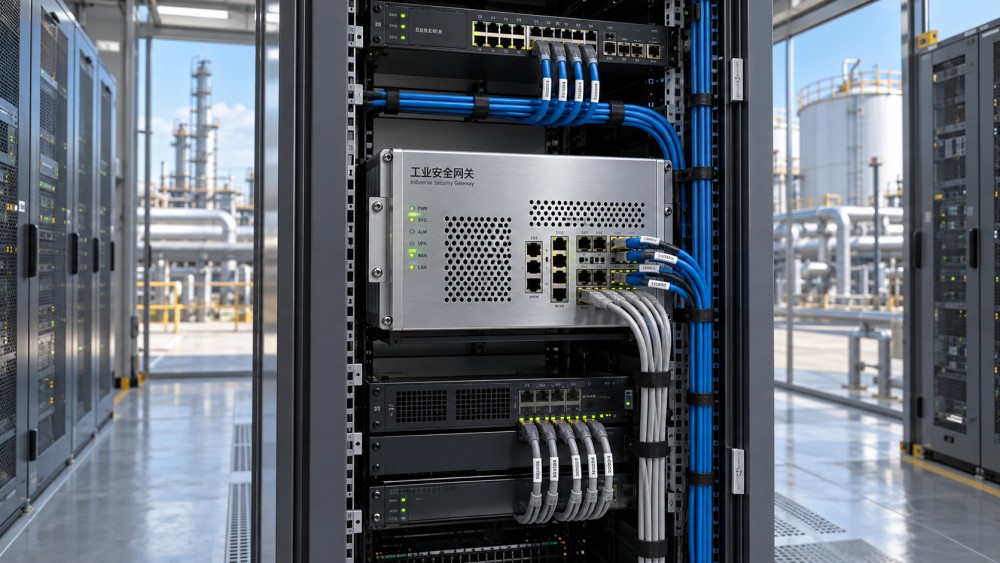
Hybrid key establishment combines a conventional mechanism with a post-quantum mechanism. In a correctly designed protocol, it can reduce reliance on either mechanism alone, but it adds implementation and interoperability considerations. Procurement specifications should identify the supported protocol, algorithm combination, update path, and downgrade behavior rather than accepting a generic “quantum-safe” label.
Key establishment and digital signatures also need separate migration plans. Updating a network tunnel does not update firmware signatures, device certificates, or the roots of trust embedded in equipment.
Could either technology interfere with control timing or safety?
Yes, if introduced without understanding where cryptographic processing occurs. Public-key operations commonly happen during connection setup or authentication, while established sessions use symmetric encryption. Consequently, a larger handshake may affect startup or reconnection more than steady-state packet forwarding.
That distinction matters during a power disturbance, network failover, or gateway restart, when many devices may reconnect together. Normal-operation throughput alone cannot show whether the design will recover acceptably.
Testing should cover:
- Connection establishment: handshake duration, concurrent sessions, and authentication failures.
- Network behavior: packet expansion, fragmentation, retransmissions, and compatibility with existing inspection devices.
- Recovery: gateway reboot, redundant-path switching, certificate renewal, and loss of time synchronization where relevant.
- Resource use: processor and memory consumption under expected peaks and reconnect bursts.
- Failure handling: alarms, fallback restrictions, and continued access to essential operational information.
Safety instrumented systems require particular care. Changes affecting their communications, independence, diagnostics, or response behavior must follow the applicable functional-safety lifecycle and plant management-of-change process. A cryptographic upgrade must not be inserted into a safety path solely because it improves a security specification.
What would a controlled pilot look like?
Choose a non-safety-critical connection with clear ownership and measurable requirements. An engineering file-transfer route or replicated historian connection may be more suitable than a controller network, provided its dependencies are understood.
- Map the existing trust path. Identify endpoints, cryptographic termination points, certificates, remote administration, and plaintext segments. Record who maintains each component.
- Set acceptance criteria before installation. Define allowable interruption, recovery behavior, resource limits, logging requirements, and the approved response to cryptographic failure.
- Test a representative configuration offline. Include actual software versions and relevant network constraints. A successful demonstration between two laptops does not establish plant compatibility.
- Exercise degraded conditions. Interrupt the protected route, restart gateways, renew credentials, and simulate unavailable key services. Confirm alarms reach the responsible operators.
- Deploy with an approved rollback. Preserve configurations and document how service is restored without silently creating an unprotected bypass.
Vendor participation is important where changes affect supported controller interfaces, secure boot, or safety-related equipment. Independent security review is especially useful for unfamiliar key-management designs or hybrid protocols.
How should costs be compared without misleading price estimates?
Compare the cost of protecting the same service to the same availability target. A QKD equipment quotation and a PQC software quotation are not comparable if one omits fiber access and the other omits gateway replacement.
For QKD, include optical-route assessment, endpoint equipment, secure accommodation, key-management integration, redundancy, specialist maintenance, and any trusted-node requirements. For PQC, account for supported hardware, firmware upgrades, certificate infrastructure, interoperability testing, and possible replacement of constrained devices.
Both options require lifecycle planning: patching, algorithm changes, credential recovery, spare equipment, and staff procedures. An implementation that cannot be updated safely may create another long-lived legacy dependency.
A useful procurement question is: “Show how this design maintains the specified service when its cryptographic component fails.” The answer often exposes integration costs that a feature comparison misses.
What should remain the priority if the plant is not ready?
Do not delay established protections while waiting for quantum-resistant equipment. Network segmentation, controlled remote access, tested backups, secure engineering workstations, monitored boundaries, and disciplined configuration management address immediate attack paths that stronger key exchange cannot remove.
At the same time, build a cryptographic inventory. Record where public-key cryptography is used, which equipment can be upgraded, how long protected information remains sensitive, and when replacements are already scheduled. Include firmware verification and long-lived trust anchors, not just encrypted network connections.
The practical decision is therefore link-specific: pursue PQC at supported communication boundaries, investigate QKD only where a high-value fixed route justifies its infrastructure, and leave validated control paths unchanged until compatibility and safety impacts are demonstrated. For replacement equipment, require a documented cryptographic update mechanism and a supported migration path before committing to another long service life.