
Search
Category
Related Industries
- When should you hire a reaction engineering consultant?When should you hire a reaction engineering consultant? Discover the key decision points for scale-up, safety, design reviews, and troubleshooting.
- Pupuk Kaltim Licenses Topsoe Technology for Low-Carbon Ammonia ProjectPupuk Kaltim licenses Topsoe’s SynCOR Ammonia technology for its planned Fakfak complex. Discover how the project aims to reduce gas use and emissions.
- How does coal quality affect gasifier selection in Southeast Asia?Choosing coal gasification systems Southeast Asia projects can rely on? Explore how moisture, ash and reactivity shape gasifier selection and plant performance.
Weekly Insights
Stay ahead with our curated technology reports delivered every Monday.
Can Satellite Links Replace Fiber Optics at Remote Offshore Refineries?




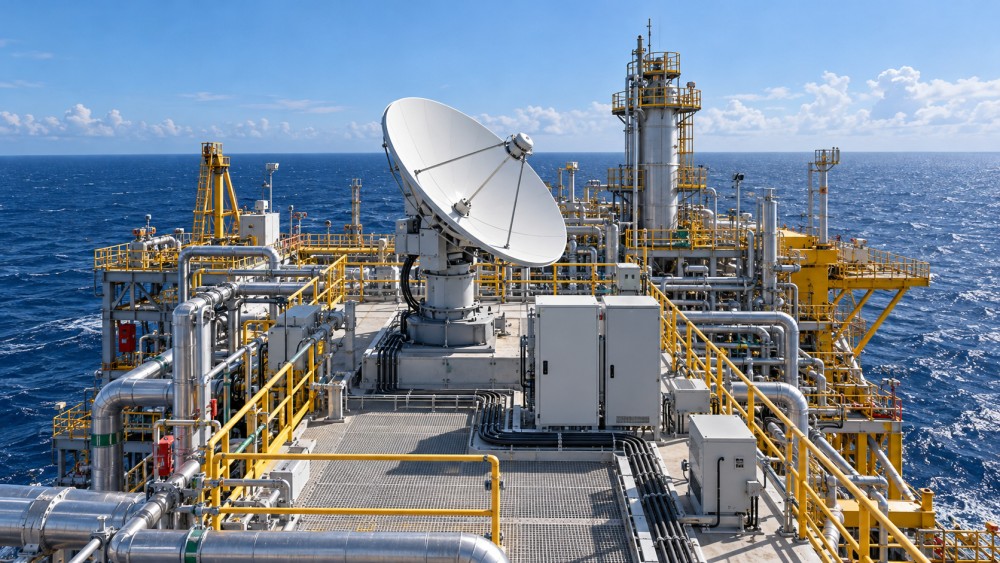
Can satellite communication replace fiber optic for remote offshore refineries? Yes, for many connections between an offshore facility and its onshore teams—but not as a universal replacement for the facility’s internal networks. Modern satellite services can carry operational reporting, maintenance data, voice, and video. Whether they should become the primary connection depends on latency, availability, weather exposure, lifecycle cost, and what must keep working when communications fail.
For an operator facing a costly subsea cable project, satellite connectivity can be an attractive alternative. Yet the decision is not simply about buying enough bandwidth. A refinery or offshore processing facility needs an architecture that keeps the process stable, protects safety functions, and gives shore-based specialists useful visibility without making plant operation dependent on a distant network.
What exactly can satellite replace—and what should remain local?
The first distinction is between offshore-to-shore backhaul and communications within the plant. These serve different purposes and should not be treated as interchangeable.
Satellite can replace a subsea fiber connection used to exchange information with headquarters, engineering centers, suppliers, and cloud platforms. It does not remove the need for local industrial Ethernet, fiber links between equipment areas, field instrumentation networks, or appropriately engineered safety communications.
Although “offshore refinery” is often used broadly, many offshore assets are production and processing platforms or floating facilities rather than conventional refineries. The connectivity principles are similar: separation, compression, heating, gas treatment, and other continuous processes must remain controlled locally.
- Good candidates for satellite: business systems, production summaries, maintenance records, condition-monitoring data, remote engineering support, and crew communications.
- Applications needing careful assessment: live video, remote operator interfaces, centralized analytics, and large engineering-file transfers.
- Functions that should not depend on shore connectivity: essential control loops, protective interlocks, emergency shutdown logic, and safety instrumented functions.
The guiding question is therefore not whether satellite can carry refinery data. It can. The question is which consequences follow when that data arrives late—or stops arriving altogether.
How do satellite and fiber compare in practical offshore service?
Fiber generally offers high capacity and low, predictable transport latency. Satellite avoids the need for a continuous physical cable route, but its performance depends on the orbital system, service plan, coverage, terminal installation, and shared network conditions.
Neither medium is automatically resilient. Two fiber services may share a cable landing station. Two satellite subscriptions may depend on the same terminal, power supply, or upstream network. Real redundancy requires checking shared failure points, not merely counting connections.
Does low-Earth-orbit satellite solve the latency problem?
It changes the discussion substantially, but it does not eliminate the need for engineering assessment.
Geostationary satellites operate roughly 35,786 kilometers above the equator. Signal travel alone creates around half a second of round-trip delay for a typical ground–satellite–ground exchange, before additional network delays. Interactive troubleshooting, remote desktops, and conversational audio can become awkward.
Low-Earth-orbit satellites are much closer, allowing substantially lower latency. However, observed end-to-end performance also depends on gateways, routing, congestion, satellite handovers, and the location of the destination application. A low average latency does not guarantee consistently low jitter or uninterrupted sessions.
For offshore engineering teams, the sensible test is application-based. Can a specialist navigate the maintenance interface comfortably? Does an approved remote-support session survive handovers? Can voice remain intelligible during heavy uploads? Those answers are more useful than an isolated speed-test result.
No satellite orbit makes a public wide-area service an appropriate default path for time-critical process control. Fast connectivity and deterministic industrial communication are different requirements.
Can satellite support remote monitoring of reactors, compressors, and heat exchangers?
Yes—particularly when the facility processes data locally before transmitting it.
A heat-exchanger monitoring application may need temperatures, pressures, flow rates, and calculated performance indicators rather than a constant stream of every raw measurement. Compressor diagnostics may transmit routine trends continuously while retaining high-frequency vibration recordings locally for scheduled or event-triggered upload.
The same principle applies to high-pressure reactor monitoring. Shore-based specialists can examine operating trends, catalyst-performance indicators, or deviations from expected thermal behavior. The local control system must still manage the process, and independent protective functions must remain effective during a communications outage.
A practical architecture follows this path:
Instruments and local control systems → local historian or edge platform → industrial demilitarized zone → managed offshore backhaul → authorized onshore applications.
Local buffering allows records to be forwarded after service returns. Alarm messages and critical operational summaries can receive higher priority than routine uploads. This reduces bandwidth pressure without discarding the information needed for process optimization, energy analysis, and equipment reliability work.
What happens during storms, obstruction, or a complete outage?
Satellite links can experience rain fade, especially at higher operating frequencies. Offshore installations also face salt exposure, wind loading, vibration, and moving obstructions. On floating assets, vessel motion and antenna tracking introduce further considerations.
A terminal positioned where a crane periodically blocks its view may deliver excellent results during commissioning and disappointing service during normal operations. Antenna placement therefore deserves a survey that considers the facility’s operating envelope—not just its condition on installation day.
Resilience measures may include separated terminals, appropriately diverse services, protected power supplies, suitable environmental enclosures, and automatic traffic prioritization. Their value depends on whether they address genuinely independent risks.
During a full external communications outage, the facility should have a defined operating mode:
- Local control and protective systems continue their intended functions.
- Operators retain access to essential procedures, displays, and records.
- Monitoring data is stored locally within planned capacity limits.
- Remote sessions terminate or recover in a controlled manner.
- Emergency communications have a separately assessed fallback.
Network failover should also be tested under realistic traffic. Restoring an internet connection does not necessarily restore an interrupted engineering session or reconcile buffered historian data correctly.
Is satellite less secure than fiber?
Neither transport medium provides a complete cybersecurity strategy. Fiber can carry compromised traffic, while satellite can carry strongly protected communications. The more important issue is how access is designed and managed.
For offshore operational technology, a satellite connection should not create a direct path from the internet to controllers. Segmentation, an industrial demilitarized zone, controlled gateways, and monitored remote-access services remain essential. IEC 62443 principles can help structure zones, conduits, and security responsibilities.
Remote maintenance access should use strong authentication, time-limited authorization, and session logging where appropriate. Access should be disabled when no longer needed. Encryption protects data in transit, but it does not prevent an authorized account from being misused or an exposed endpoint from being compromised.
Operators should also check practical service details: public or private addressing, carrier-grade network address translation, VPN compatibility, gateway locations, and applicable data-transfer restrictions. These can determine whether an existing security design works over a new satellite service.
When is satellite actually cheaper than subsea fiber?
Satellite often has an economic advantage when the site is distant, the cable route is difficult, the asset has limited remaining life, or connectivity is needed before permanent infrastructure can be installed. Fiber becomes more compelling where sustained data volumes are high, several assets can share infrastructure, or decades of operation justify the initial investment.
A useful comparison evaluates the same service requirements over the same operating period. It should include:
- Installation: marine surveys, cable works, permits, terminals, mounting, and network integration.
- Recurring service: committed capacity, priority allowances, support, and additional traffic charges.
- Maintenance: offshore access, replacement equipment, specialist labor, and cable-repair arrangements.
- Resilience: backup links, independent power, spare equipment, and failover management.
- Operational impact: the consequences of lost remote support, delayed diagnostics, or unavailable business systems.
Comparing a basic satellite subscription with an engineered, redundant fiber service is misleading. Equally, specifying fiber capacity far beyond any credible requirement can distort the business case in the opposite direction.
For process-industry investment analysis, the CS-Pulse perspective is to connect communications spending with operating outcomes: equipment availability, maintenance responsiveness, energy visibility, and continuity—not bandwidth alone.
Is a hybrid satellite–fiber network usually the better choice?
Where fiber already exists, retaining it as the primary path and adding satellite as an independently engineered backup is often sensible. The satellite link can preserve essential communications during a cable outage without carrying every normal workload.
Where fiber is impractical, satellite may become the primary backhaul, supported by another suitably independent connection where feasible. Depending on location, alternatives might include a separate satellite system, microwave, or coastal cellular service. Availability must be verified rather than assumed.
Traffic policy matters as much as link selection. During failover, production reporting, operational voice, and approved support sessions may deserve priority. Crew streaming, bulk backups, and nonurgent software downloads can be restricted. Otherwise, lower-priority traffic may consume the capacity intended for continuity.
What should operators verify before replacing fiber?
Before committing, run a site-specific trial using representative applications and realistic loads. Include poor-weather periods where practicable, antenna obstructions, peak demand, and deliberate failover tests. Review the service-level agreement carefully: availability definitions, measurement points, exclusions, support response, and remedies all matter.
The acceptance criteria should answer five questions:
- Which applications must remain available, and what delay or interruption can each tolerate?
- Does the service deliver adequate upload capacity, not just download speed?
- Can the facility operate safely and predictably without shore connectivity?
- Are backup paths independent enough to address credible failures?
- Does the lifecycle cost include resilience, security, maintenance, and operational consequences?
Satellite can replace fiber as the offshore-to-shore connection when the workload, service performance, and outage strategy support that choice. It should not replace the local communications and protective architecture on which safe processing depends. For many remote facilities, the strongest answer is not satellite versus fiber, but a deliberate combination of local autonomy, selective data transmission, and genuinely diverse external links.