
Search
Category
Related Industries
- Sinopec and BASF Release Product Carbon Footprint Verification ResultsSinopec and BASF release product carbon footprint verification results, advancing consistent accounting and emissions management across chemical supply chains.
- How to assess process safety compliance in an FCC unitStrengthen refinery processing compliance with a practical guide to assessing FCC hazards, operating limits, safeguards, mechanical integrity, and emergency readiness.
- 17th China International Petrochemical Conference Opens in ZhanjiangThe 17th China International Petrochemical Conference in Zhanjiang explores low-carbon development and new materials. Discover what buyers and suppliers should watch.
Weekly Insights
Stay ahead with our curated technology reports delivered every Monday.
Methylcyclohexane Production Costs: Hydrogen Price and Recycle Economics




Hydrogen pricing can reshape methylcyclohexane project margins, but fresh hydrogen purchases tell only part of the story. For commercial evaluators assessing methylcyclohexane production plant cost, recycle-loop design, purge losses, compression power, and catalyst performance can materially change both capital requirements and operating expenditure.
A proposal with the lowest installed cost may consume more hydrogen throughout its operating life. A more elaborate recovery system may reduce purchases yet lose its advantage through electricity demand, maintenance, or reduced availability. The purchasing decision is therefore not simply “Which plant uses less hydrogen?” It is “Which configuration delivers on-spec product at the lowest defensible lifecycle cost?”
This CS-Pulse analysis examines toluene hydrogenation economics, separating the chemistry’s unavoidable requirements from losses that engineering can control. The objective is a clearer basis for comparing supplier proposals and testing investment resilience—not a universal plant price detached from location, capacity, and scope.
Start with the material balance, not the equipment quotation
The conventional synthesis route hydrogenates toluene to methylcyclohexane, commonly abbreviated as MCH:
C7H8 + 3H2 → C7H14
Using molecular weights, the theoretical requirements are approximately 938 kg of toluene and 61.6 kg of hydrogen per tonne of MCH. These figures describe ideal chemical consumption. They do not include hydrogen leaving in purge gas, dissolved gas losses, hydrocarbon losses, off-spec production, or consumption by side reactions.
That distinction matters when reviewing vendor guarantees. “Hydrogen consumption” might mean the stoichiometric requirement, fresh hydrogen entering the battery limits, or hydrogen supplied during stable operation only. Those are different commercial commitments.
Ask every bidder to provide a reconciled material balance on the same basis: one tonne of saleable MCH at the specified purity. Include startup and shutdown consumption separately, then incorporate their expected annual frequency into the financial model.
Hydrogen price sensitivity has a useful floor
At ideal consumption, every $1/kg change in hydrogen price changes direct hydrogen cost by approximately $61.6 per tonne of MCH. Actual exposure will generally be higher because fresh supply must also cover unrecovered losses and any additional consumption.
A practical screening relationship is:
Hydrogen cost per tonne of saleable MCH = fresh hydrogen purchased per tonne × delivered hydrogen price.
Delivered price deserves emphasis. A headline production price may exclude purification, compression, transport, storage, metering, and supplier charges. Hydrogen available at insufficient pressure or unsuitable purity is not economically equivalent to hydrogen delivered at the reactor system’s required conditions.
For on-site hydrogen, avoid treating an internal transfer price as a complete economic answer. Check the underlying energy cost, maintenance, capital recovery, and alternative value of that hydrogen elsewhere in the site. For purchased supply, examine minimum offtake obligations and price-escalation formulas alongside the nominal unit rate.
Toluene remains another major cost driver. A hydrogen-focused comparison should not hide differences in liquid recovery, product yield, or feedstock quality. Small hydrocarbon losses can offset apparent savings elsewhere.
Where methylcyclohexane production plant cost actually accumulates
A hydrogenation package price is not necessarily an installed plant price. Commercial comparisons become more reliable when the investment is divided into clearly defined cost blocks.
Working capital, initial inventories, financing during construction, and owner’s costs may sit outside the quoted total. A credible comparison identifies these exclusions explicitly rather than applying one broad markup to every proposal.
Recycle is valuable—but circulating gas is not free hydrogen
Hydrogenation systems commonly use hydrogen in excess of the amount reacted in a single pass. After cooling and separation, hydrogen-rich gas can return to the reactor rather than being discarded. This reduces fresh makeup requirements compared with a configuration that loses more unreacted hydrogen.
However, the recycle ratio is not the same as hydrogen utilization. A large circulating flow may support reactor operation without proving that the plant loses little hydrogen overall. Fresh consumption depends on the complete balance: reaction demand, purge composition and flow, recovery performance, and other losses.
The loop normally needs a purge because nonreactive components and gaseous byproducts can accumulate. Reducing that purge indiscriminately can lower hydrogen partial pressure and alter reactor performance. The apparent saving may then return as poorer conversion, greater circulation requirements, or operating instability.
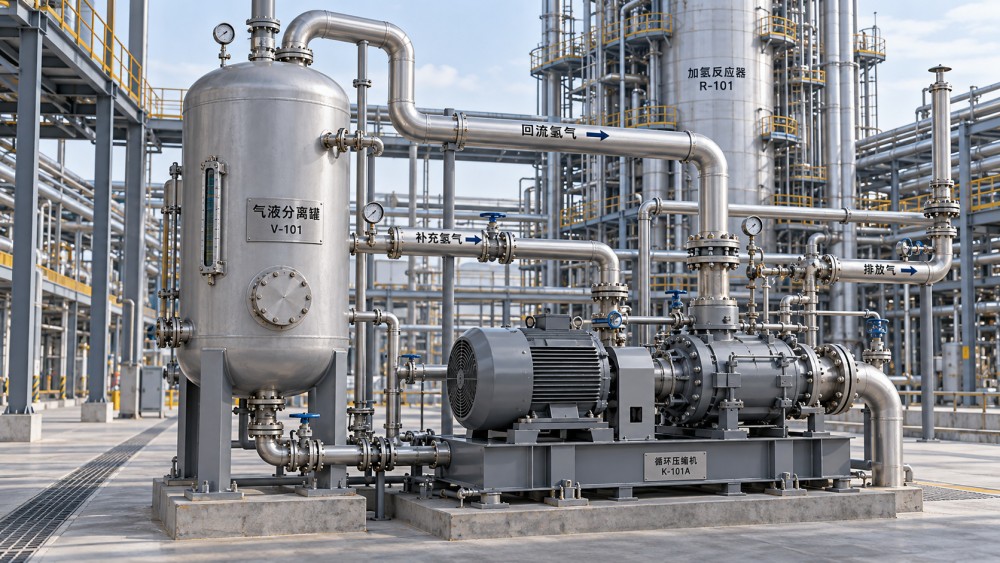
A useful process diagram should distinguish fresh hydrogen, reactor recycle, separator liquid, purge gas, and any recovered-hydrogen return. Procurement teams should request flow, pressure, temperature, and composition at these points—not just a single headline recycle percentage.
The decision is usually between three economic positions
- A simpler recycle loop: lower equipment complexity, with hydrogen losses accepted through the necessary purge.
- Improved separation and purge management: tighter control of avoidable losses without necessarily adding a dedicated recovery unit.
- Additional hydrogen recovery: a membrane, pressure swing adsorption system, or another suitable arrangement recovering hydrogen from a qualifying gas stream.
None is automatically best. Recovery technology must be evaluated against actual gas composition, flow variability, available pressure, recovered-gas purity, and return pressure. A recovery percentage without those conditions is not a bankable performance claim.
A worked comparison: when recovery only narrowly pays
Consider an illustrative plant producing 100,000 tonnes of saleable MCH annually. Assume identical product quality and hydrocarbon yield in both cases, and define net hydrogen utilization as stoichiometric hydrogen incorporated into saleable product divided by fresh hydrogen purchased.
Using the theoretical requirement of 61.6 kg/t, improving utilization from 95% to 99% reduces fresh hydrogen purchases from approximately 64.8 to 62.2 kg/t. The saving is about 2.6 kg per tonne of MCH.
At an assumed delivered hydrogen price of $4/kg, that represents roughly $10.5/t, or $1.05 million annually. These are scenario assumptions, not market quotations or vendor performance benchmarks.
Suppose the additional recovery investment is $5 million. With an illustrative annual capital charge factor of 15%, annualized capital cost is $750,000. If incremental electricity, maintenance, and other operating costs total $200,000 annually, the combined annual burden is $950,000.
The resulting advantage is only about $100,000 per year before taxes and other project-specific effects. It can disappear with lower throughput, higher power prices, or weaker recovery performance. If hydrogen instead costs $2/kg, the gross hydrogen saving approximately halves, while much of the added cost remains.
The useful screening equation is:
Break-even hydrogen price = incremental annualized cost ÷ annual reduction in purchased hydrogen.
Include compression and other recurring costs in the numerator. Deduct any lost purge-gas fuel credit from the recovery benefit. For investment approval, extend this screening calculation into a discounted cash-flow model with realistic operating years and replacement costs.
Four operating details that can overturn the spreadsheet
Compression depends on pressure losses, not just flow
Recycle compressor power reflects gas flow, composition, suction conditions, pressure ratio, and efficiency. Increasing circulation raises energy demand, while higher pressure drop across reactors, exchangers, or recovery equipment can raise it further. Request compressor duty at normal operation, turndown, and relevant end-of-run conditions.
Recovered hydrogen may also require recompression. Ignoring that duty can make a recovery option look attractive on a mass balance and disappointing on the electricity bill.
Heat recovery has value only where the site can use it
Toluene hydrogenation is exothermic. Reactor heat management is essential for temperature control, catalyst protection, and safe operation. Feed preheating or useful heat export may reduce utility expenditure, but only when temperature levels, timing, and site demand match.
Do not credit all released heat as saleable energy. Require a heat balance showing recoverable duty, exchanger approach temperatures, cooling requirements, and the investment needed to realize the benefit.
Catalyst performance changes the annual average
Catalyst selection affects activity, selectivity, operating conditions, and sensitivity to feed contaminants. A low initial catalyst price is not necessarily a low lifecycle cost. Replacement frequency, regeneration where applicable, disposal, and shutdown duration all matter.
Compare guaranteed performance across the expected operating cycle, not only immediately after startup. Feed contaminant limits should be aligned with the actual toluene and hydrogen supply contracts.
Availability determines how widely fixed costs are spread
An additional recovery train introduces equipment, controls, and maintenance requirements. Establish whether the plant can continue safely at reduced efficiency when that train is unavailable. If not, a modest hydrogen saving may carry a disproportionate production risk.
Model annual saleable output rather than nameplate capacity. Fixed operating costs and capital charges become more expensive per tonne when utilization falls.
What a decision-ready supplier proposal should contain
Before comparing prices, issue a common design basis covering feed composition, hydrogen delivery conditions, product specification, site utilities, annual operating hours, and battery limits. Then require bidders to disclose:
- Fresh hydrogen and toluene consumption per tonne of saleable product, with calculation boundaries.
- Purge flow and composition, recovery performance, and any fuel-value assumptions.
- Electricity, heating, and cooling duties under consistent operating conditions.
- Catalyst life assumptions, replacement costs, and performance guarantees.
- Installed-cost inclusions, exclusions, contingency basis, and commissioning scope.
- Performance at turndown, during recovery-unit outages, and near catalyst end of run.
Evaluate at least a base case, a low-hydrogen-price case, and a combined downside case with reduced throughput and higher utility costs. This reveals whether an option genuinely improves resilience or merely wins under one favorable price assumption.
For commercial evaluators, the strongest methylcyclohexane production plant cost assessment connects process engineering to contract terms. Buy neither the lowest equipment price nor the highest recovery percentage in isolation. Favor the configuration whose material balance, energy demand, operating flexibility, and guarantees remain credible when conditions become less forgiving.