
Search
Category
Related Industries
- 17th China International Petrochemical Conference Opens in ZhanjiangThe 17th China International Petrochemical Conference in Zhanjiang explores low-carbon development and new materials. Discover what buyers and suppliers should watch.
- How pressure affects conversion in the methanol synthesis processExplore how pressure affects conversion in the methanol synthesis process. Discover how to balance methanol yield, energy costs, and equipment limits for better plant performance.
- How to scope a process safety engineering audit for an FCC unitScope a process safety engineering audit for your FCC unit with scenario-led boundaries, safeguard checks, and evidence priorities. Learn how to focus your review on critical risks.
Weekly Insights
Stay ahead with our curated technology reports delivered every Monday.
Budgeting a Methyl Cyclohexane Plant: Storage, Utilities, and Safety Systems




Budgeting a Methyl Cyclohexane Plant: Storage, Utilities, and Safety Systems
A credible methyl cyclohexane production plant cost estimate extends well beyond reactors and separation equipment. Storage capacity, utility infrastructure, and safety systems can change both the investment requirement and the commissioning schedule. A competitive process-package quotation may still leave the owner responsible for substantial work outside the supplier’s battery limits.
The budgeting challenge is not simply remembering more equipment. It is identifying which operating assumptions create that equipment: feedstock delivery frequency, hydrogen availability, summer cooling conditions, product-release procedures, and the site’s emergency-response capability. These assumptions need to be visible before competing quotations can be compared fairly.
Define the production route and the estimate boundary
Methylcyclohexane, also written as methyl cyclohexane or MCH, can be produced through toluene hydrogenation. For this route, hydrogen supply and removal of reaction heat are fundamental design issues. A project purchasing hydrogen from an established pipeline has a different infrastructure requirement from one installing hydrogen generation, purification, compression, and backup supply.
Before asking for prices, issue a common design basis covering annual saleable output, operating hours, turndown, feed composition, product specification, and available utilities. Specify hydrogen pressure and purity at the actual plant connection—not merely at the supplier’s source. Residual toluene and other quality limits can affect separation duty, recycle arrangements, and off-specification storage.
Keep three cost boundaries separate: the process package, total installed plant cost, and total project funding. The last may include land, owner’s engineering, permitting, initial catalyst, commissioning materials, inventory, working capital, and financing costs. A quotation is not incomplete simply because it excludes these items, but the investment model is incomplete if nobody carries them.
This is where the cross-disciplinary perspective behind CS-Pulse’s process intelligence is useful: reactor conditions, gas quality, and heat-exchanger performance should be evaluated together. Treating them as unrelated purchasing packages can hide costs at their interfaces.
Size storage around logistics, not a convenient number of days
Storage capacity should follow a material-flow scenario. Consider a plant receiving toluene by road while dispatching MCH in larger, less frequent shipments. Feedstock inventory and finished-product inventory will have different drivers. Using the same storage allowance for both may tie up unnecessary capital on one side while leaving the other vulnerable to a missed delivery.
A practical starting calculation is daily throughput multiplied by the required coverage period. Then account for delivery parcels, unusable tank heel, operating limits, and contingency stock. Convert mass to volume using density at the relevant design conditions. Nominal tank capacity is not usable working capacity; filling limits and vapor space still apply.
Tank count can matter as much as total volume. One large product tank may appear economical until quality release requires a batch to remain isolated while production continues. Separate receipt, testing, and dispatch functions may justify multiple tanks. Where specifications are tight, an off-specification or rework tank also needs a defined destination and recovery procedure.
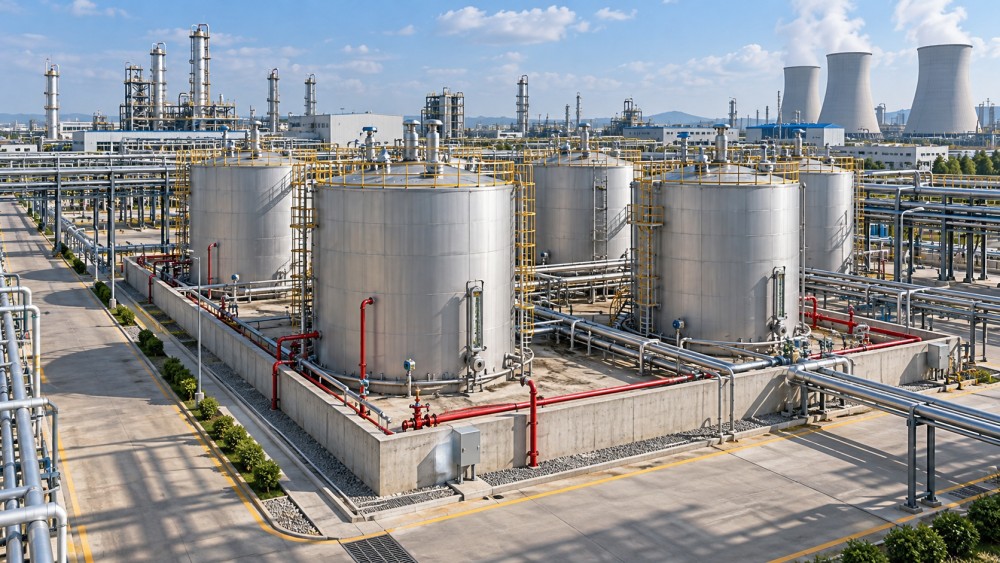
Price the complete tank installation: foundations, secondary containment, pumps, piping, level measurement, overfill protection, access, drainage, and loading facilities. Tank spacing and fire-access requirements can increase land development and pipe runs. Rainwater management within containment areas is another real operating cost, particularly where potentially contaminated water requires treatment.
MCH is a flammable liquid. Nitrogen blanketing may be selected for particular tanks, but it is not a substitute for correctly designed normal and emergency venting. Blanketing pressure, tank vacuum resistance, emissions controls, and nitrogen-failure response must be coordinated. Budget nitrogen consumption for filling, withdrawal, and purging—not just a small steady leakage allowance.
Utility capacity must cover difficult operating conditions
For a toluene-hydrogenation plant, reaction heat removal deserves early engineering attention. The utility estimate should be based on a heat-and-material balance covering normal operation, turndown, startup, and credible disturbances. Selecting cooling equipment from an average annual duty is not a defensible shortcut.
Cooling and heat recovery
Cooling-water temperature affects exchanger area, achievable process temperatures, and potentially operating limits. Evaluate the site’s summer design conditions and realistic fouling allowances. An existing cooling tower may have spare nominal capacity without sufficient hydraulic capacity at the proposed connection.
Compare air cooling, cooling water, and any supplementary cooling against local weather, water availability, electricity cost, and maintenance capability. Include pumps, fans, water treatment, blowdown handling, and distribution piping. Heat recovery may reduce purchased energy, but only where a suitable heat sink is available at the right temperature and operating schedule. Do not credit all recoverable heat as a cash saving.
Hydrogen, nitrogen, and electrical supply
Hydrogen supply options should be compared on delivered pressure, purity, availability, and total ownership cost. Compression, buffer capacity, purification, and supply interruptions can outweigh an attractive unit price. Feed contaminants must be checked against catalyst requirements; “industrial hydrogen” is not a sufficiently detailed purchasing specification.
Nitrogen and instrument air require both normal and intermittent demand estimates. Startup purging can create a peak that routine operation never approaches. Likewise, electrical budgeting must include motor starting, transformers, switchgear, cable routes, grounding, and any backup required for safe shutdown. An uninterruptible power supply for controls does not keep a cooling-water pump running.
For brownfield projects, request verified utility data rather than accepting “available on site.” Confirm pressure, temperature, quality, spare capacity, tie-in location, and shutdown requirements. A distant utility header or congested cable route can turn a modest connection into a substantial construction package.
Safety costs emerge from scenarios, not a percentage allowance
Applying a flat safety allowance to equipment cost is useful only as an explicitly preliminary placeholder. Hydrogen service, flammable-liquid storage, and exothermic reaction hazards need scenario-based assessment. A HAZOP and, where appropriate, layer of protection analysis help establish safeguards, independence requirements, and further engineering work.
The resulting scope can include emergency isolation valves, independent trips, gas and flame detection, relief systems, depressurization facilities, and fire protection. Not every project needs the same configuration. A safety instrumented function, for example, should follow the hazard assessment and required risk reduction rather than being included as an unexplained “SIL-rated package.”
Relief disposal is a frequent interface risk. A vendor may include relief valves while excluding discharge piping and the destination system. Establish whether releases can enter an existing flare or require another engineered arrangement. Check receiving-system capacity, backpressure, liquid handling, and the consequences of simultaneous relief scenarios where applicable.
Firewater demand needs a defined design basis too. Pumps, storage, ring mains, hydrants, and any foam or cooling systems must suit the assessed hazards and applicable local requirements. Containment of firefighting runoff can add civil works and wastewater capacity that are absent from the equipment list.
Relevant references may include NFPA 30 for flammable and combustible liquids, API 2000 for applicable tank-venting design, IEC 60079 for explosive atmospheres, and IEC 61511 for process-sector safety instrumented systems. Their applicability, editions, and legal status require jurisdiction-specific confirmation. They are design references, not a universal compliance checklist.
Make supplier bids comparable before negotiating price
The lowest package price may simply have the shortest scope. Issue a responsibility matrix identifying who designs, supplies, installs, tests, and commissions each interface. The matrix should cover process connections, utilities, electrical distribution, control-system integration, drainage, and relief disposal.
For bid clarification, ask suppliers to state:
- Guaranteed production and quality conditions, including feed and utility assumptions.
- Normal, peak, startup, and shutdown utility requirements, with calculation boundaries.
- Equipment design conditions, materials, inspection scope, and site assembly requirements.
- Exclusions, recommended spares, catalyst supply, commissioning support, and performance-test responsibilities.
- Delivery milestones, document-release dates, and obligations if stated performance is not achieved.
Separate engineering assumptions from commercial exclusions. “Cooling water supplied by owner” defines responsibility; it does not demonstrate that the required temperature or flow is achievable. Similarly, a factory-tested skid still needs site integration, loop checks, and agreed acceptance criteria.
Build contingency around unresolved scope
A defensible methyl cyclohexane production plant cost estimate identifies what is known, what remains provisional, and what could change. Estimate maturity matters more than the apparent precision of the final number. Early process calculations, budget quotations, and firm installation bids should not be presented with equal confidence.
Keep contingency distinct from escalation, foreign-exchange exposure, and owner-directed scope changes. Tie risk allowances to identifiable uncertainties: geotechnical conditions, utility upgrades, hazardous-area equipment availability, construction productivity, or unresolved emissions-control requirements. Avoid counting the same uncertainty in both a vendor allowance and the project contingency.
Test a few decisions that can materially change the investment: longer product-storage coverage, hotter cooling-water supply, or loss of the proposed hydrogen source. These sensitivities show where additional engineering or a supply agreement is worth more than another round of price negotiation.
Before approving the baseline, close three gaps: a workable inventory plan, verified utility availability, and a preliminary safety-system scope with assigned responsibilities. If any remains unresolved, show the associated allowance and schedule exposure explicitly. That is a more reliable basis for procurement than a precise-looking total built around unpriced connections.