
Search
Category
Related Industries
- TfS and CPCIF Renew Strategic Cooperation on Chemical Supply Chain SustainabilityChemical supply chain sustainability takes center stage as TfS and CPCIF renew cooperation on carbon accounting, ESG standards and the low-carbon transition.
- How to verify supplier references before signing with a distributorVerify supplier solution references distributors provide before signing. Learn what to ask, spot warning signs, and reduce delivery and compliance risks.
- Sinopec and BASF Release Product Carbon Footprint Verification ResultsSinopec and BASF release product carbon footprint verification results, advancing consistent accounting and emissions management across chemical supply chains.
Weekly Insights
Stay ahead with our curated technology reports delivered every Monday.
Methyl Sulfonate Plant Costs: Why Chemical Identity Must Be Confirmed First




A credible methyl sulfonate production plant cost estimate begins with an exact product identity. The phrase “methyl sulfonate” does not establish a sufficiently clear engineering basis: it may reflect an incomplete name for a methanesulfonate salt or ester, or confusion with another sulfur-containing chemical. Those possibilities can require different feedstocks, reaction systems, containment measures, and separation equipment.
For technical evaluators, the initial decision is whether competing proposals describe the same product and supply scope. Until molecular structure, composition, saleable form, and quality requirements are aligned, a lower quotation may simply represent a different chemical or a less demanding specification. A preliminary budget can still support early screening, provided its assumptions are explicit and it is not treated as an investment-ready estimate.
Resolve the name before comparing process routes
Methanesulfonic acid, its salts, and its esters share a chemical relationship, but they are distinct products. Methanesulfonic acid has the structure CH3SO3H. A methanesulfonate salt contains the CH3SO3− anion paired with a specified cation. A methanesulfonate ester has the general structure CH3SO2OR, with the identity of the organic group affecting product properties and manufacturing requirements.
Methyl methanesulfonate, CH3SO2OCH3, is one specific ester. It should not be confused with sodium methanesulfonate, another metal methanesulfonate, or methyl sulfate compounds. Sulfates and sulfonates have different bonding arrangements; similar wording does not justify transferring process assumptions between them. In particular, methyl methanesulfonate is an alkylating chemical with significant health hazards, making its identity consequential for containment and handling decisions.
The product definition should therefore combine several identifiers. A CAS number is useful, but an identifier alone cannot describe the concentration, hydration state, impurity profile, or physical form of a commercial material. A solution and a dry solid may share the same principal chemical identity while requiring substantially different plant sections.
Before requesting comparable engineering quotations, establish:
- Chemical identity: an unambiguous name, structural formula, CAS number, and the counterion or organic substituent where applicable.
- Delivered composition: active content, solvent or water content, and any intentionally added components.
- Acceptance limits: assay, residual acidity or alkalinity, relevant inorganic and organic impurities, moisture, and other application-specific requirements.
- Commercial form: solution, liquid product, crystalline solid, or powder, together with packaging and storage conditions.
- Production basis: annual saleable output, operating schedule, product mix, and expected campaign sizes.
These details should appear in a common product specification attached to every request for quotation. If a project includes several grades, each needs its own acceptance criteria; a single nominal purity figure can conceal materially different purification duties.
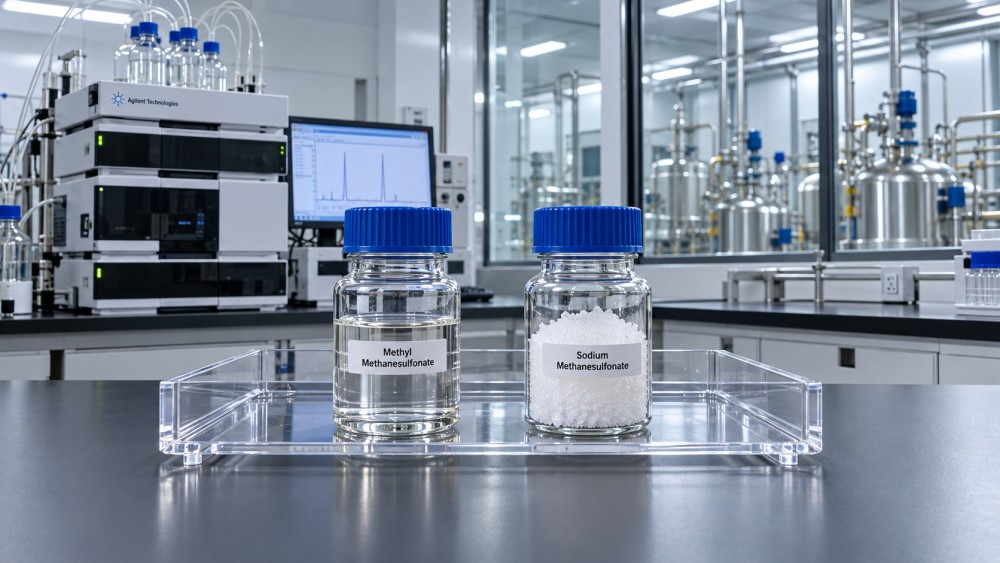
Chemical identity determines what the plant must actually do
Once the product is defined, the next comparison concerns manufacturing scope. Producing a methanesulfonate salt from purchased methanesulfonic acid and a suitable base is a different investment from manufacturing the acid upstream and then converting it. An ester production route introduces another set of reaction, purification, and exposure-control questions. These alternatives should not be grouped under one generic plant cost.
Salt production: finishing can outweigh reaction complexity
For a salt made by neutralization, the reaction section may appear straightforward. However, the selected base, feed concentrations, heat release, solubility, and product specification determine how straightforward the complete process will be. Depending on the chemistry, gas evolution, insoluble material, or excess reagent may require additional handling.
A product sold as an aqueous solution may need controlled reaction, polishing filtration, concentration adjustment, and storage. A dry product can require evaporation, crystallization, solid-liquid separation, drying, and enclosed packing. Each additional operation brings utility demand, product losses, cleaning requirements, and maintenance. A budget based only on the neutralization vessel can therefore miss much of the installed scope.
The cation also affects the economics. Feedstock cost must be calculated from stoichiometric consumption, delivered concentration, and usable quality. Comparing reagent prices per tonne without accounting for those differences can favor a feedstock that creates higher water-removal costs or introduces impurities that are difficult to remove.
Ester production: selectivity and containment affect the equipment list
For a methanesulfonate ester, the exact organic group and selected route influence conversion, side reactions, residual reagents, and purification options. The feasibility of distillation or another separation method depends on the actual mixture and its thermal behavior. An evaluator should not assume that a generic distillation package will deliver the required quality.
Where the product or intermediates present significant exposure hazards, closed transfers, sampling arrangements, ventilation, maintenance access, and waste handling become part of the process design. These provisions affect both installed cost and routine operating effort. Their adequacy must follow the chemical hazard assessment and intended operating conditions.
For methyl methanesulfonate specifically, its alkylating properties warrant particular attention to operator exposure and contamination control. The cost comparison should show how each proposal addresses charging, sampling, product transfer, equipment opening, and cleaning. A cheaper reactor package provides little decision value if these necessary interfaces remain undefined.
Upstream integration changes the investment question
Manufacturing an upstream intermediate may reduce dependence on purchased material, but it also expands the project boundary. Additional synthesis, purification, storage, emissions control, and utility systems can alter the capital requirement and operating organization. Integration deserves a separate business case based on throughput, feedstock access, technical maturity, and site capability.
Purchased-intermediate and integrated-production options should therefore be compared as complete alternatives. Assigning an assumed internal transfer price to an intermediate without including the facilities needed to make it can make integration look artificially attractive.
The specification can move costs more than nominal capacity
Two plants with the same annual nameplate output can have different economics because they produce different saleable grades. Residual water, free acid, metals, color-forming impurities, or trace organic contaminants may determine whether a batch can be released. The relevant limits depend on the application; technical evaluators should resist adding demanding specifications unless they serve a defined customer requirement.
Tighter limits can require cleaner feedstocks, additional purification, segregated storage, different wetted materials, or more extensive analytical capability. They may also reduce recovery. A process that achieves a high assay through repeated purification can consume more raw material and generate more waste per tonne of accepted product than a simpler route.
Material selection needs the same discipline. Compatibility depends on the complete process environment, including temperature, concentration, water content, contaminants, and cleaning chemicals. A material suitable for finished-product storage may be unsuitable in a reaction or concentration step. Broad statements such as “stainless steel construction” leave too much uncertainty for meaningful cost comparison.
Thermal behavior also needs evidence appropriate to the route. Reaction heat, decomposition potential, gas generation, and the consequences of cooling or agitation failure can influence feed systems, cooling capacity, relief provisions, and operating limits. An equipment estimate made before these questions are examined should carry clearly identified design allowances.
Waste treatment is another place where product identity and specification converge. An aqueous stream containing dissolved salts presents different treatment questions from one containing reactive organic residues. Neutralizing pH does not by itself establish that a stream is suitable for discharge or biological treatment. The estimate should identify expected streams, relevant contaminants, and the proposed treatment or disposal route.
For an existing site, available treatment capacity must be assessed against the new stream’s characteristics. Spare hydraulic capacity alone does not establish compatibility. If the project depends on an untested assumption about waste acceptance, that assumption belongs among the principal investment risks.
Build a cost comparison around saleable output and a common boundary
After the chemistry and quality basis are fixed, the cost model becomes much more useful. Capital should cover the facilities required to receive feedstocks, manufacture and finish the product, verify quality, manage waste, and deliver the specified commercial form. A skid price represents only the scope listed in that quotation.
For each proposal, distinguish process equipment from the installed project. Piping, instrumentation, electrical work, civil works, containment, ventilation, utilities, engineering, commissioning, and site integration can materially affect the total. A project at an established chemical site may use shared infrastructure, but the estimate must account for available capacity and any necessary modifications.
The most useful operating-cost denominator is a tonne of accepted, saleable product at the specified concentration or form. Comparing a dilute solution with a dry product on gross shipped mass produces a misleading result. Even an active-content comparison needs adjustment when drying, packaging, or customer handling requirements differ.
A practical operating-cost model should include feedstocks at demonstrated or defensible consumption rates, utilities, labor, maintenance, quality control, consumables, waste treatment, and packaging. Recovery, off-spec production, cleaning losses, and startup losses should be visible assumptions. Theoretical stoichiometry provides a baseline; it does not establish commercial consumption.
Annual capacity also needs scrutiny. A batch process must accommodate charging, reaction, cooling, separation, transfer, cleaning, and release-related constraints. For multiple products, changeovers and campaign scheduling can reduce usable production time. Dividing annual demand by reaction time alone can understate the equipment and storage required.
Rather than forcing every uncertainty into one contingency percentage, test the assumptions that could change the decision. Depending on the route, these may include feedstock price, product recovery, evaporation duty, batch cycle time, achievable annual output, or waste disposal cost. Sensitivity analysis helps distinguish a commercially resilient option from one that works only under favorable assumptions.
What makes an estimate ready for a decision?
A screening estimate is useful when it identifies a plausible route and shows whether further development is justified. It becomes suitable for a stronger investment decision as the underlying evidence improves: a defined product specification, a coherent material and energy balance, demonstrated purification performance, a credible equipment basis, and a clear site scope.
Before selecting a proposal, ask the engineering team to connect each major cost item to a process requirement. The evaporator should follow the water balance; the purification section should follow the impurity limits; containment should follow the hazard assessment; waste treatment should follow the expected stream composition. This makes omissions easier to detect and prevents expensive equipment from being justified through generic assumptions.
If chemical identity remains unresolved, the next useful expenditure is a focused definition exercise involving the product owner, process engineer, and analytical specialist. Once they agree on the molecule, saleable grade, and production boundary, quotations can answer the commercial question: what will it cost to make this specified product reliably, at this site, and at the required output?