
Search
Category
Related Industries
- When should you hire a reaction engineering consultant?When should you hire a reaction engineering consultant? Discover the key decision points for scale-up, safety, design reviews, and troubleshooting.
- Pupuk Kaltim Licenses Topsoe Technology for Low-Carbon Ammonia ProjectPupuk Kaltim licenses Topsoe’s SynCOR Ammonia technology for its planned Fakfak complex. Discover how the project aims to reduce gas use and emissions.
- How does coal quality affect gasifier selection in Southeast Asia?Choosing coal gasification systems Southeast Asia projects can rely on? Explore how moisture, ash and reactivity shape gasifier selection and plant performance.
Weekly Insights
Stay ahead with our curated technology reports delivered every Monday.
Industrial Power Plant EPC: Matching Steam Turbines to Process Loads




A steam turbine can meet its rated electrical output and still be poorly matched to an industrial plant. If its exhaust pressure is unsuitable for production, its minimum steam flow exceeds overnight demand, or its controls cannot accommodate a process trip, the owner may need extensive throttling, bypass operation, or curtailed generation. The selection problem begins with the steam users, not the generator nameplate.
For an industrial power plant EPC project, the preferred turbine configuration depends on how process heat demand, boiler capability, and electrical operating requirements overlap. Technical evaluators need to compare complete steam-system operating cases rather than isolated turbine efficiencies. The U.S. Department of Energy’s steam-system guidance supports this systems approach: generation, distribution, end use, and recovery must be evaluated together.[1]
Build the selection basis around process steam demand
A single “normal steam consumption” figure is not an adequate design basis. Industrial consumers may require different header pressures, operate in batches, or change demand independently. A dryer section, evaporator train, and steam-driven auxiliary can impose very different operating patterns even when connected to the same network.
Prepare a steam-consumer register showing required pressure at the equipment inlet, acceptable temperature or superheat, expected flow range, and operating schedule. Distinguish pressure required at the user from pressure required at the turbine outlet: distribution losses and control-valve pressure drops must be accommodated. Record whether each demand is continuous, interruptible, seasonal, or associated with startup.
The load assessment should include coincident operating cases, rather than simply adding every consumer’s maximum demand. Useful cases include:
- Normal production with representative electrical and steam demand.
- Maximum credible simultaneous process consumption.
- Minimum production with the intended boiler combination online.
- Loss of a major steam consumer or an operating boiler.
- Plant startup before normal process steam demand is established.
- Future expansion, identified separately from the initial guaranteed duty.
For each case, establish the required header conditions and identify where surplus steam could go. This exposes a common selection error: choosing a turbine for an attractive full-load power figure without demonstrating that the site can absorb its exhaust throughout the operating schedule. DOE guidance and the EPA’s steam-turbine CHP overview both explain the relationship between useful thermal demand and cogeneration performance.[1][2]
Choose the steam path before fixing generator capacity
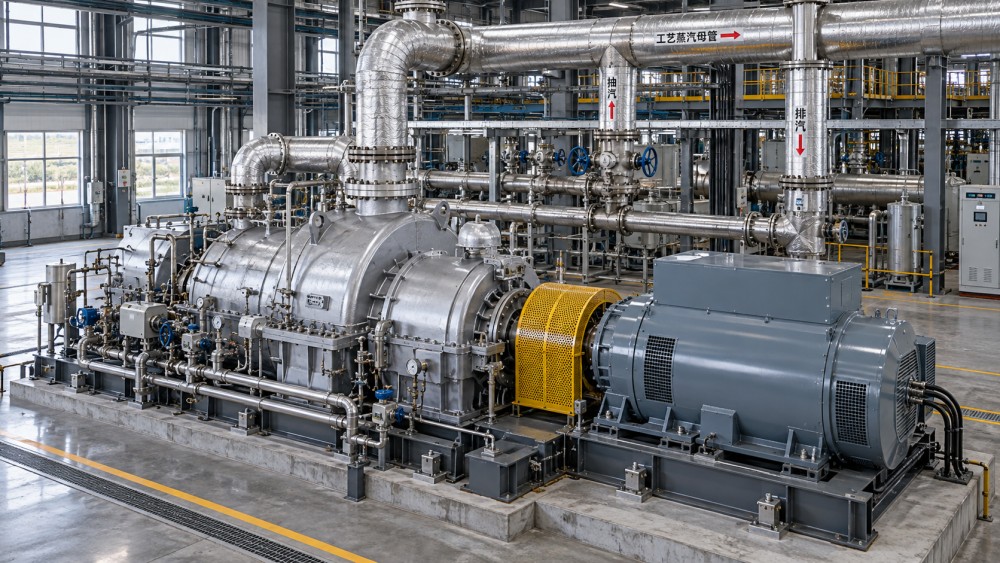
Backpressure, extraction-condensing, and extraction-backpressure arrangements address different balances between heat delivery and power generation. None is inherently the best choice for every industrial owner.
A backpressure turbine is often a strong candidate where a stable process heat sink already exists. It expands steam toward a pressure that remains useful to production. However, lower process consumption can restrict generation unless the system has another acceptable steam destination. Bypassing the turbine may maintain process supply during an outage, but it does not recover the electrical work that turbine expansion could provide.[1][2]
An extraction-condensing arrangement offers more flexibility between thermal delivery and electrical generation, within the machine’s operating limits. That flexibility brings additional equipment and operating obligations: condenser, cooling system, vacuum equipment, and associated auxiliaries. Where cooling water is constrained or seasonal cooling conditions are unfavorable, these requirements may materially affect selection.[2]
Specify whether extraction pressure must be actively controlled. An uncontrolled extraction point changes pressure with operating conditions and should not be assumed to maintain a process header within its required range. Ask for the allowable operating envelope, including extraction-flow limits and minimum flow through downstream turbine sections, rather than one rated-point heat balance.[2]
Compare heat balances at the same boundaries
Vendor comparisons become unreliable when one proposal quotes generator-terminal output and another quotes net plant output. Define the assessment boundary before requesting bids. Identify whether cooling-system power, boiler auxiliaries, feedwater pumping, fuel handling, water treatment, and transformer losses are included in each figure.
At turbine level, power depends on steam mass flow, the available enthalpy drop, expansion efficiency, and mechanical and electrical losses. Actual inlet conditions matter: pressure losses between boiler and turbine, inlet temperature variation, and exhaust pressure can change achievable output. Steam properties and heat-balance calculations should use a consistent, identified calculation basis across all proposals.[1][2]
Require each bidder to calculate the agreed operating cases using the same inlet and process-header conditions. The evaluation should distinguish guaranteed points from estimates and show:
- Steam admitted, extracted, exhausted, and bypassed.
- Gross electrical output and the agreed auxiliary deductions.
- Delivered steam pressure, temperature, and flow at each contractual boundary.
- Boiler operating assumptions, including blowdown and feedwater conditions where relevant.
- Cooling conditions and condenser pressure for condensing configurations.
Do not use a backpressure turbine’s electrical efficiency alone to compare it with a condensing machine. Their useful outputs differ: one retains substantial energy in steam supplied to production, while the other rejects heat through its condensing system. Compare fuel input against both electricity and useful process heat, using a consistent accounting method. The EPA’s CHP catalog explains why the heat-and-power balance is central to steam-turbine CHP assessment.[2]
Test the operating envelope against disturbances
A steady-state heat balance cannot establish whether the steam system will remain workable during production changes. The owner should ask how boiler controls, turbine governing, extraction-pressure control, pressure-reducing stations, and electrical controls interact. DOE’s steam-system sourcebook provides the broader basis for evaluating these connected supply and demand functions.[1]
Consider a major process consumer shutting down. Header demand falls while steam generation may take time to respond. The engineering assessment should establish how turbine admission, extraction control, boiler firing, and any alternative steam path respond, and whether the resulting conditions remain within equipment limits. The required response depends on the actual system; it cannot be inferred from rated turbine capacity.
The reverse event deserves equal attention. A turbine trip can remove a process steam supply path while production still needs heat. Where continuity is required, evaluate a pressure-reducing and desuperheating bypass against the necessary flow, pressure range, temperature control, and response time. A bypass valve’s nominal capacity alone does not demonstrate acceptable downstream conditions.[1]
Electrical operating philosophy also changes the specification. Grid-parallel operation, export restriction, and islanded operation impose different control requirements. If island operation is required, request a dedicated assessment of generation-load balance, load shedding, auxiliary supply, and recovery sequences. Turbine CHP systems can support different electrical arrangements, but the required functionality must be engineered for the site rather than assumed from the presence of a generator.[2]
Make EPC interfaces visible in the procurement package
The turbine package is only one part of the steam system. An equipment list for a thermal power plant does not establish who owns pressure losses, control integration, water chemistry requirements, or process-header performance. Those responsibilities should appear in an interface matrix accompanying the technical specification.
When assessing power plant EPC support, technical evaluators should distinguish equipment supply scope from responsibility for system integration. The procurement package should identify who develops the overall heat balance, confirms boiler–turbine compatibility, coordinates steam and condensate interfaces, and demonstrates operation across the agreed load cases. A broad scope description is not a substitute for explicit deliverables and battery limits.
Interfaces worth assigning individually include main-steam conditions at the turbine stop valve, extraction and exhaust connection conditions, condensate-return assumptions, feedwater-system boundaries, cooling services, generator interconnection, and control-system communications. Define responsibility for piping loads and thermal expansion assessment as well as the location where pressure and temperature guarantees apply.
Steam purity requires a separate discussion from bulk water-treatment capacity. Boiler carryover and contamination can affect turbine deposits and operating condition; acceptable limits depend on the equipment and treatment regime.[1] Request the turbine supplier’s applicable steam-quality requirements, sampling provisions, and operating restrictions, then check that the boiler and water-treatment design can support them.
Evaluate lifecycle value without assuming perfect operation
The highest rated output may not produce the strongest operating economics. Compare alternatives over representative production periods, using the owner’s expected hours at each load condition. Include purchased electricity, export terms where applicable, fuel, cooling, water treatment, auxiliary consumption, and maintenance assumptions. EPA guidance identifies thermal utilization and operating conditions as major factors in steam-turbine CHP economics.[2]
Run sensitivities where commercial assumptions are uncertain. A configuration dependent on electricity exports may become less attractive under restrictive export conditions. A condensing section may add flexibility but provide limited value if it operates infrequently. Conversely, a lower-capital backpressure arrangement may expose production to unacceptable constraints if process steam demand falls below the intended operating range.
Maintenance access should be reviewed before the layout is frozen. Ask the engineering team to demonstrate rotor removal space, lifting arrangements, access to valves and auxiliaries, and the proposed isolation boundaries. Obtain vendor-specific inspection intervals and maintenance requirements rather than applying a generic availability assumption to every proposal.
Turn acceptance into a defined operating demonstration
The purchase specification should state which performance quantities will be demonstrated, where they will be measured, and how deviations from reference conditions will be treated. Specify the test boundary, instrumentation responsibilities, allowable uncertainty, correction method, and treatment of unavailable process loads. ASME PTC 6 provides a recognized performance-test framework for steam turbines; its applicability and contractual use should be agreed for the particular project.[3]
Keep performance testing separate from functional verification. A satisfactory power measurement does not, by itself, establish extraction-pressure response, bypass operation, or the agreed electrical operating modes. Define those demonstrations in project-specific procedures with supplier participation and owner review.
The final selection should be supported by an operating-case matrix, comparable heat balances, a documented operating envelope, and assigned interface responsibilities. A turbine that meets the plant’s recurring steam conditions—and has a credible response when those conditions change—is a stronger engineering choice than one selected primarily for its nameplate megawatts.
Sources
[1] U.S. Department of Energy, Improving Steam System Performance: A Sourcebook for Industry, Second Edition. Guidance on steam generation, distribution, end use, recovery, and system-level assessment.
[2] U.S. Environmental Protection Agency, Catalog of CHP Technologies, Section 4: Technology Characterization—Steam Turbines. Reference for turbine configurations, heat-and-power relationships, performance, and application considerations.
[3] ASME, PTC 6: Steam Turbines. Performance test code; the applicable edition and project-specific testing arrangements should be identified in the contract.