
Search
Category
Related Industries
- How to scope a process safety engineering audit for an FCC unitScope a process safety engineering audit for your FCC unit with scenario-led boundaries, safeguard checks, and evidence priorities. Learn how to focus your review on critical risks.
- PetroChina Ethylene Output Rises 26.4% to Record First-Nine-Month Level in 2026PetroChina ethylene output rose 26.4% to a record in the first nine months of 2026. Explore what expanded capacity could mean for feedstock supply and downstream producers.
- What should a petrochemical reactor package quotation include?Compare petrochemical reactor package quotations with confidence. Discover essential scope, design, testing, and commercial terms to uncover hidden costs and make smarter purchasing decisions.
Weekly Insights
Stay ahead with our curated technology reports delivered every Monday.
Liquid Sulphur Dioxide Plant Costs: Liquefaction, Storage, and Containment




A liquid sulphur dioxide quotation can look complete until the project team asks where the feed gas comes from, who supplies the drying system, and what happens during a loss of refrigeration. Estimating liquid sulphur dioxide production plant cost means pricing an operating facility—not simply a compressor, condenser, and storage vessel.
For project managers, the difficult decisions sit between process design and commercial scope. Feed-gas purity determines separation duty. Storage philosophy changes pressure ratings, utility demand, and emergency provisions. Toxic-release safeguards influence layout, drainage, electrical systems, and construction quantities. A credible investment estimate must connect these decisions before competing supplier prices can be compared fairly.
Define what “production plant” includes before discussing price
The first cost question is whether the project produces sulphur dioxide or receives it from another process. A plant burning sulphur needs feed handling, combustion equipment, air supply, heat management, and gas conditioning. A project recovering SO2 from an existing gas stream may instead need substantial pretreatment and concentration. A facility receiving dry, concentrated SO2 starts much closer to liquefaction.
These are different investments, even if their liquid output is identical. Comparing them using a single cost-per-tonne-of-capacity benchmark can conceal more than it reveals.
For an early budget, record both the included scope and the assumptions behind it. “Utilities available” is not sufficient: specify their pressure, temperature, capacity, reliability, and connection location.
Feed quality sets the liquefaction cost curve
Two plants producing the same annual tonnage can have very different compression and cooling requirements. The decisive issue is often the composition of the incoming gas, rather than nameplate capacity alone.
Concentration and non-condensables
A concentrated SO2 feed generally presents a different separation problem from a dilute stream containing substantial nitrogen, oxygen, or carbon dioxide. Non-condensable gases reduce SO2 partial pressure and can increase the pressure or cooling effort needed to achieve a specified recovery. They also create a purge stream that may require recovery or treatment.
Ask bidders to state product recovery, product purity, and SO2 losses together. A lower-priced package may achieve its apparent saving by accepting more sulphur dioxide in the tail gas, transferring expenditure to the emissions-control system.
Moisture and contaminants
Moisture is a major materials and reliability concern. Wet SO2 service can be corrosive, while sufficiently dry service may permit different material choices. The purchasing specification should therefore define inlet moisture, the required outlet moisture limit, verification methods, and the response to an off-spec condition.
Particulates, acid mist, and other contaminants can affect compressors, exchangers, dryers, and product acceptance. Their removal generates additional duties: filter changes, regeneration, chemical replenishment, or waste disposal. A single “typical feed” analysis is a weak basis for procurement when the upstream process varies materially.
Pressure, cooling conditions, and operating range
SO2 boils at approximately −10°C at atmospheric pressure. Liquefaction therefore requires a suitable combination of pressure and temperature; atmospheric-pressure condensation is not achievable with ordinary cooling water alone. The economic balance between compression and refrigeration depends on feed conditions, local utilities, and the storage destination.
Evaluate summer cooling conditions and minimum stable throughput, not just the design point. A system that performs well at full load may consume disproportionately more energy during extended low-rate operation.
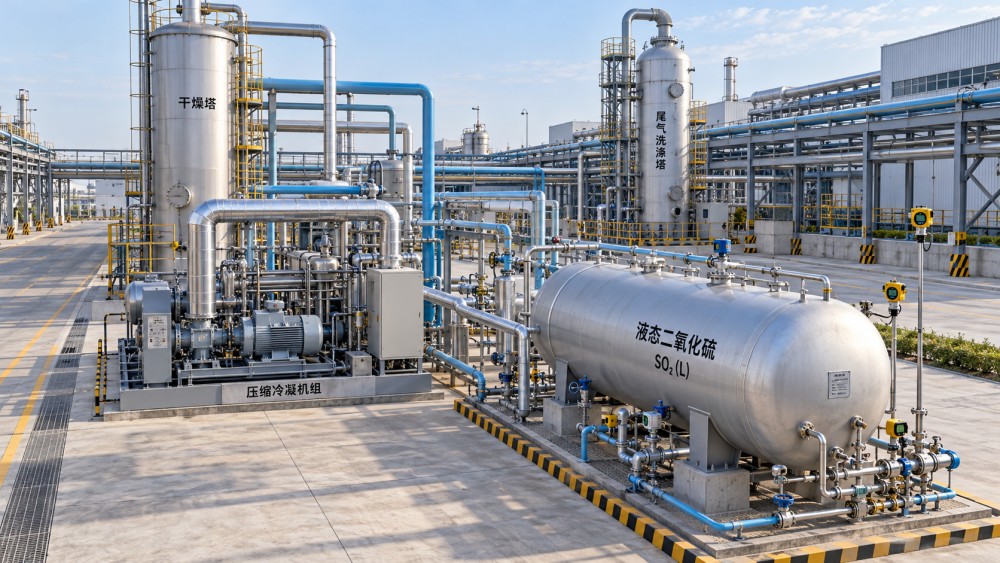
Pressurized or refrigerated storage: compare the whole system
Storage is often treated as a downstream purchase. In practice, it helps determine the liquefaction design, transfer arrangements, and emergency strategy. Working inventory should follow production continuity and dispatch requirements—not an arbitrary number of storage days.
Neither option is automatically cheaper or safer. Smaller inventories may favor pressure storage in some projects; larger inventories can justify evaluating refrigerated alternatives. The crossover depends on site conditions, vessel availability, logistics, and protection requirements. It should be established through project-specific engineering rather than a universal capacity threshold.
Specify usable inventory, not only nominal vessel volume. Filling limits, operating heel, thermal expansion allowance, and unavailable inventory affect dispatch capacity. Additional storage may protect production during transport interruptions, but it also increases hazardous inventory, inspection obligations, and potentially land requirements.
Containment is more than a bund wall
Sulphur dioxide is a toxic inhalation hazard. A liquid release can flash and generate a hazardous vapor cloud; physical liquid retention alone does not resolve that risk. Containment budgeting must address prevention, detection, isolation, mitigation, and emergency response as an integrated system.
Depending on the site and applicable requirements, the estimate may need to include:
- Release prevention: suitable materials, controlled connections, overfill protection, equipment protection, and inspection access.
- Rapid detection and isolation: appropriately located SO2 detectors, alarms, remote isolation, and clearly defined shutdown actions.
- Vapor and relief management: engineered handling of vents and credible relief loads, including treatment where required.
- Loading safeguards: compatible transfer connections, emergency shutdown interfaces, vehicle controls, and hose-management provisions.
- Emergency infrastructure: safe access and escape routes, communications, response equipment, and arrangements for contaminated runoff.
Emergency scrubbing deserves its own design basis. A scrubber for routine purge gas is not automatically suitable for a major emergency discharge. Required capacity depends on the defined scenarios, discharge rates, duration, absorption performance, utility availability, and resulting effluent. Scrubbing chemicals, replenishment, corrosion control, and waste handling belong in the operating estimate too.
Likewise, water application is not a generic containment solution. Any water-based mitigation must be engineered for its specific purpose, including its interaction with released liquid and the handling of contaminated water. Hazard studies and dispersion analysis should guide the layout and safeguards before procurement freezes the equipment arrangement.
Build the liquid sulphur dioxide production plant cost estimate in layers
Without capacity, location, feed composition, product specification, and a defined scope, a dollar figure would imply more certainty than the available information supports. A more useful early estimate separates purchased equipment from the cost of making that equipment operable.
Total project investment should account for process packages, storage, utilities and offsites, civil and structural works, piping, electrical installation, instrumentation, engineering, construction management, commissioning, owner’s costs, and contingency. Taxes, freight, duties, escalation, and currency assumptions should be visible rather than buried in a supplier total.
Apply estimating allowances to the appropriate scope. A packaged liquefaction unit with substantial internal piping should not receive the same installation treatment as a bare equipment list. Conversely, a low package price should not obscure extensive site-built connections.
Separate the main sources of uncertainty:
- Definition uncertainty: incomplete equipment sizing, preliminary layouts, and unconfirmed utility loads.
- Execution risk: site access, ground conditions, construction productivity, and integration shutdowns.
- Commercial exposure: exchange rates, freight, delivery timing, and bid validity.
Contingency is not a substitute for known missing scope. If emergency treatment or a power connection is required, include it explicitly. For brownfield sites, verify spare utility capacity and equipment condition before assigning a saving to existing infrastructure.
Use cost per saleable tonne—not just power per tonne
Operating expenditure includes feedstock or feed-gas charges, electricity, cooling utilities, drying consumables, treatment chemicals, maintenance, inspections, labor, waste management, and compliance activities. The denominator should be saleable product, accounting for recovery losses, off-spec production, startup losses, and realistic availability.
A practical calculation is:
Cash operating cost per saleable tonne = annual cash operating expenditure ÷ annual saleable liquid SO2 output.
Keep this distinct from a levelized production cost that also incorporates capital recovery and financing assumptions. Mixing these definitions can make competing investment options appear misleadingly attractive.
Request utility consumption at the same feed composition, ambient conditions, throughput, and product specification. Then test the investment against lower utilization, higher electricity prices, feed-quality deterioration, and dispatch delays. These sensitivities often reveal whether a cheaper package remains cheaper in operation.
Make supplier proposals answer the same questions
Before issuing the request for quotation, prepare a common technical and commercial basis. Bidders should receive feed ranges, annual operating hours, turndown requirements, storage autonomy, utility limits, site conditions, and applicable design requirements. Where information is uncertain, require a stated assumption and a priced alternative.
For bid evaluation, insist on clear answers to the following:
- What capacity, purity, recovery, and utility consumption are guaranteed, and under which conditions?
- Where are the battery limits, and who owns each mechanical, electrical, control, and safety interface?
- Which routine vents, purge streams, relief scenarios, and wastes are included in the design basis?
- What happens during loss of power, cooling, instrument air, or feed drying performance?
- Which spare parts, inspections, operator training, and commissioning activities are included?
- How will performance testing be conducted, and what contractual remedies apply if guarantees are not met?
For the project manager approving expenditure, the strongest proposal is not necessarily the lowest equipment quotation. It is the proposal with a defensible process basis, explicit interfaces, realistic operating costs, and a containment strategy supported by site-specific risk assessment. Once those elements align, the budget becomes something the project can manage—not merely a number it hopes to achieve.