Search
Category
Related Industries
- How slag viscosity affects entrained flow gasifier performanceDiscover how slag viscosity affects entrained flow gasifier drainage, efficiency, and wall durability—and learn what to evaluate for more reliable operation.
- How to assess oversupply risk with olefins market intelligenceUse olefins market intelligence to assess oversupply risk through capacity, demand, costs, and trade flows. Discover how to strengthen procurement and investment decisions.
- How grid bottlenecks shape energy infrastructure investment in EuropeExplore energy infrastructure Europe can rely on: discover how grid bottlenecks, connection risks and storage economics shape investment decisions and project value.
Weekly Insights
Stay ahead with our curated technology reports delivered every Monday.
Which chemical industry techniques improve energy efficiency at scale?




Energy efficiency at chemical-plant scale is rarely delivered by a single equipment upgrade. The largest and most durable reductions in energy intensity usually come from techniques that improve how heat, pressure, reaction conditions, separations, and plant-wide controls work together. For technical evaluators, the practical question is not which technology has the highest claimed efficiency in isolation. It is which intervention reduces utility demand without creating a throughput constraint, increasing operational instability, or narrowing safety margins.
Across petrochemical processing, coal-based synthesis, industrial gas production, and high-pressure reaction systems, five areas deserve early attention: heat integration, advanced process control, reactor and furnace optimization, high-efficiency separation, and targeted electrification or low-carbon process redesign. Their value depends heavily on the operating envelope of the existing plant. A heat-recovery project may have a stronger business case than a new separation package in a site with large temperature mismatches. A control upgrade may outperform both where energy loss is driven by variability rather than equipment design.
Start with the energy balance, not the equipment list
Many chemical industry techniques are evaluated too narrowly: a new exchanger is compared with an old exchanger, or a compressor upgrade is assessed only against its own power draw. That approach can miss the largest opportunities because chemical plants are coupled systems. A change to one duty can alter steam generation, cooling-water demand, refrigeration load, column reflux, furnace firing, compressor operating points, and product recovery elsewhere.
The first useful screen is therefore a site or unit energy balance built around the real operating case, not just design data. Evaluators should identify where energy enters the process, where it is upgraded or degraded, and where it finally leaves as stack loss, cooling load, low-pressure steam, hot condensate, flare loss, or unrecovered hot product. The analysis should distinguish between steady-state losses and losses caused by unstable operation, fouling, off-spec production, turndown, or frequent transitions.
That distinction changes the investment decision. A plant operating close to design capacity with stable feedstock may benefit most from structural heat integration. A unit that frequently shifts feed composition or production grade may recover more value from better control, more flexible separation, or improved fouling management. Energy consumption per tonne is an important indicator, but it should be reviewed alongside conversion, selectivity, on-stream factor, utility constraints, and maintenance exposure.
Heat integration remains the highest-leverage technique in many large plants
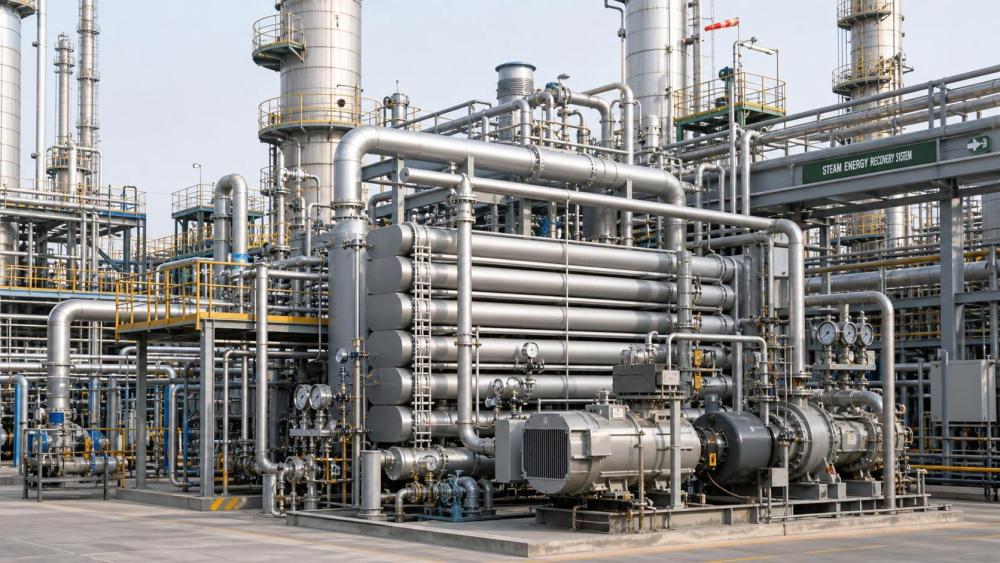
Large heat-exchanger networks are often the most consequential energy assets in a chemical complex. Refining, steam cracking, reforming, gasification, synthesis gas conditioning, distillation, and acid-gas processing all produce hot streams while simultaneously requiring heat elsewhere. Recovering that heat can reduce fuel firing and steam demand, but the useful result depends on temperature level, timing, fouling behavior, controllability, and pressure constraints.
Pinch analysis and heat-exchanger network optimization provide a disciplined way to assess these interactions. Rather than asking where another exchanger can be inserted, they identify the minimum external heating and cooling targets for a defined process configuration. This helps distinguish genuine recovery opportunities from projects that merely move duty into another utility system.
For existing facilities, the best retrofit options are commonly more selective than a complete network redesign. They may include:
- Recovering high-temperature process heat to preheat combustion air, boiler feedwater, process feed, or dilution steam.
- Using reactor or furnace effluent more effectively before it reaches a cooling service.
- Improving condensate recovery and flash-steam use where the receiving process has a stable thermal demand.
- Replacing undersized, bypassed, or heavily fouled exchangers that force extra furnace firing or refrigeration load.
- Adding heat pumps, mechanical vapor recompression, or vapor recompression only where the temperature lift and operating profile support the added electrical demand.
Exchanger performance should not be judged only by nominal heat-transfer area. Fouling resistance, allowable pressure drop, metallurgy, cleaning access, thermal stress, and control response can determine whether an attractive heat-recovery calculation survives operation. A retrofit that pushes a critical reactor-feed circuit close to its pressure-drop limit, for example, can reduce compressor or pump margin and create a more expensive bottleneck than the fuel savings justify.
High-temperature recovery deserves special scrutiny in cracking furnaces, reformers, gasifiers, and high-pressure synthesis loops because the energy is valuable, but the service is demanding. Corrosion mechanisms, particulate deposition, coking, thermal cycling, and tube-skin-temperature limits need to be reviewed together. The best concept on a heat-and-mass balance may be unsuitable if it adds an unacceptable failure mode in a hard-to-isolate location.
Advanced process control captures losses created by variability
Plants do not consume energy at a single ideal operating point. Feed quality changes, ambient conditions shift, catalysts age, equipment fouls, and operators must respond to production priorities. When control systems maintain wide safety buffers or repeatedly correct large deviations, utility consumption rises even if every major item of equipment is mechanically sound.
Advanced process control, often implemented through multivariable predictive control, can reduce this operational waste by coordinating interacting variables. Typical applications include furnace firing and excess oxygen control, distillation pressure and reflux optimization, compressor anti-surge operation, steam-header balancing, hydrogen-network management, refrigeration systems, and air separation units. The aim is to hold the process closer to its economic and technical limits while respecting constraints on quality, equipment protection, emissions, and safety.
The energy benefit depends on the quality of the underlying plant information. Unreliable flow measurement, drifting analyzers, poorly maintained control valves, or inconsistent laboratory data will limit any optimizer. Before funding a sophisticated layer of control, evaluators should ask whether the base control loops are stable, whether the instrument architecture can support the required calculation cycle, and whether process constraints are clearly defined and accepted by operations.
It is also important not to treat optimization as a substitute for engineering correction. A controller can redistribute heat and pressure more efficiently, but it cannot permanently offset a severe exchanger fouling problem, damaged furnace convection section, leaking steam trap population, or compressor operating outside its intended range. In those cases, control may reveal the loss more clearly, while the physical repair remains the primary energy project.
Reaction and furnace improvements can lower energy per tonne, but conversion alone is not enough
Reaction severity is closely linked to energy use in many chemical processes. Higher temperatures, pressures, recycle ratios, or residence times may improve one aspect of production while imposing penalties elsewhere. A catalyst with higher activity can lower a required reaction temperature, for example, but its value depends on selectivity, cycle length, sensitivity to contaminants, pressure drop, regeneration requirements, and downstream separation effects.
For fired heaters and cracking furnaces, the relevant techniques include combustion optimization, air-preheat integration, radiant-coil monitoring, convection-section recovery, reduced air ingress, and scheduling that avoids prolonged low-efficiency operation. Excess oxygen cannot simply be minimized without considering combustion stability, carbon monoxide formation, burner behavior, and applicable emissions obligations. The useful operating target is site-specific and should be supported by reliable oxygen measurement and furnace safety logic.
In catalytic reactors, improvements may come from better temperature distribution, enhanced quench control, feed distribution, catalyst grading, lower-pressure-drop internals, or revised recycle operation. These changes can reduce energy consumption indirectly by improving selectivity and reducing the volume of material that must be compressed, heated, separated, or recycled. In high-pressure polymerization, hydrocracking, hydrogenation, and synthesis applications, hydraulic and thermal changes require particular care because a small deviation in mixing, heat removal, or pressure control can carry significant safety consequences.
Computational fluid dynamics can be useful when flow maldistribution, stagnant zones, or hot spots are plausible causes of poor energy performance. It should answer a specific engineering question, such as whether a new distributor improves residence-time distribution or whether an internal modification raises local velocity beyond erosion limits. A visually detailed model is not, by itself, evidence of an economic improvement. The predicted result still needs to be connected to validated process data, operability limits, and maintainability.
Separation efficiency often determines whether upstream savings are retained
Distillation, refrigeration, compression, adsorption, drying, and gas purification can account for a substantial share of utility consumption in chemical value chains. In many cases, upstream heat recovery or reactor improvements are diluted by inefficient separation operation. This is especially relevant when a product specification is tight, feed composition varies, or a purification train has been adapted over time for new grades and capacity expansions.
Distillation projects should begin by identifying the real source of energy demand. It may be excessive reflux, a pressure level selected for older utility conditions, tray damage, poor liquid distribution, column flooding risk, condenser limitations, reboiler fouling, or unstable feed composition. High-capacity internals can increase throughput or lower pressure drop, but they do not automatically reduce energy. Their benefit must be assessed against the chosen pressure, relative volatility, heat-integration options, and product-quality control strategy.
For hydrogen recovery, carbon dioxide removal, nitrogen generation, and specialty gas purification, pressure swing adsorption, membranes, cryogenic separation, and solvent-based systems each occupy different operating territories. PSA optimization can reduce compression and purge losses when cycle timing, equalization steps, feed pressure, adsorbent condition, and product recovery are well matched. Yet a higher recovery target may demand more compression work or reduce product purity margin. The correct choice depends on the full cost of purity, pressure, recovery, and reliability, rather than on recovery percentage alone.
Heat-integrated distillation, dividing-wall columns, vapor recompression, and hybrid separation systems can be compelling where the process has a stable duty and a sufficiently long operating horizon. They are less attractive where production campaigns are short, the feed envelope is uncertain, or shutdown access is limited. Evaluators should examine start-up behavior and upset recovery as carefully as the normal operating model. A configuration that saves energy only under narrow steady-state conditions may create an operational burden that erodes its annual value.
Electrification and low-carbon conversion need a system-level test
Electrifying process heat, installing electric boilers, adding heat pumps, or integrating carbon capture can change the energy profile of a plant substantially. These measures may support decarbonization objectives, but electrical efficiency and emissions performance are not interchangeable. The decision must account for the source and reliability of electricity, grid connection capacity, operating-hour profile, steam-system consequences, and the role of existing cogeneration assets.
Carbon capture is a similar case. Capture systems can be necessary for certain decarbonization pathways, particularly where concentrated carbon dioxide streams are available. They also add thermal and electrical demand through solvent regeneration, compression, dehydration, transport preparation, or auxiliary systems. A credible evaluation therefore treats capture as an integrated utility and process-design question, not as a bolt-on emissions device. Heat recovery from adjacent process units, steam-quality requirements, cooling availability, and compressor staging can materially affect its energy penalty.
Green ammonia, e-methanol, and other low-carbon conversion routes introduce further tradeoffs. Electrolysis, hydrogen compression, synthesis-loop integration, water treatment, storage, and intermittency management all shape the final energy requirement. Technical teams should separate the efficiency of an individual conversion step from the efficiency and availability of the complete production system.
How to prioritize an efficiency program
A practical program usually starts by ranking opportunities through a small set of common tests. First, determine whether the project removes an unavoidable utility duty or merely transfers it to another system. Second, test its performance across expected feed, ambient, throughput, and product-grade conditions. Third, identify effects on safety, controllability, availability, inspection, and maintenance. Finally, value lost production opportunity and outage requirements alongside fuel or power savings.
The strongest projects are often those that combine a physical improvement with a better operating strategy: an exchanger-network modification supported by updated control logic, a furnace upgrade paired with combustion monitoring, or a separation retrofit designed around revised heat integration. Technical evaluators should favor proposals that show the interaction between these elements, state their operating assumptions clearly, and preserve room for the plant to handle real disturbances. Energy efficiency at scale is ultimately an exercise in managing thermodynamics without sacrificing the operating resilience that keeps a chemical facility productive.