Search
Category
Related Industries
- What drives heat exchanger technology cost in new process projects?Heat exchanger technology cost depends on duty, materials, pressure, fouling, and installation. Learn how to control project budgets, reduce risk, and compare bids smarter.
- How bearing preload affects turbine reliability in aerospace systemsAerospace bearings for turbines: discover how precise preload control improves rotor stability, reduces skidding and heat, and supports reliable aerospace turbine performance.
- When carbon capture integration services reduce project delivery riskCarbon capture integration services reduce delivery risk by aligning utilities, tie-ins, controls, permitting, and CO2 transport for reliable industrial project execution.
Weekly Insights
Stay ahead with our curated technology reports delivered every Monday.
Chemical Process Intelligence for Faster Fault Detection




For operators under constant pressure to keep units safe, stable, and efficient, chemical process intelligence turns scattered plant signals into faster, clearer decisions. In petrochemical trains, coal conversion, gas refining, and high-pressure reactors, it helps teams detect faults earlier, reduce downtime, and respond with greater confidence in complex, high-risk environments.
The shift is moving from alarms to decisions
Across heavy process industries, the pain point is no longer a lack of data. The real issue is speed. A compressor drift, a heat exchanger fouling pattern, or an unstable reactor temperature can appear first as small signal changes, then grow into production loss. Chemical process intelligence helps compress that delay.
Instead of depending only on fixed thresholds, modern plants are using layered analytics, contextual models, and event correlation. That means fault detection becomes more than alarm counting. It becomes a live interpretation of how process variables behave together.
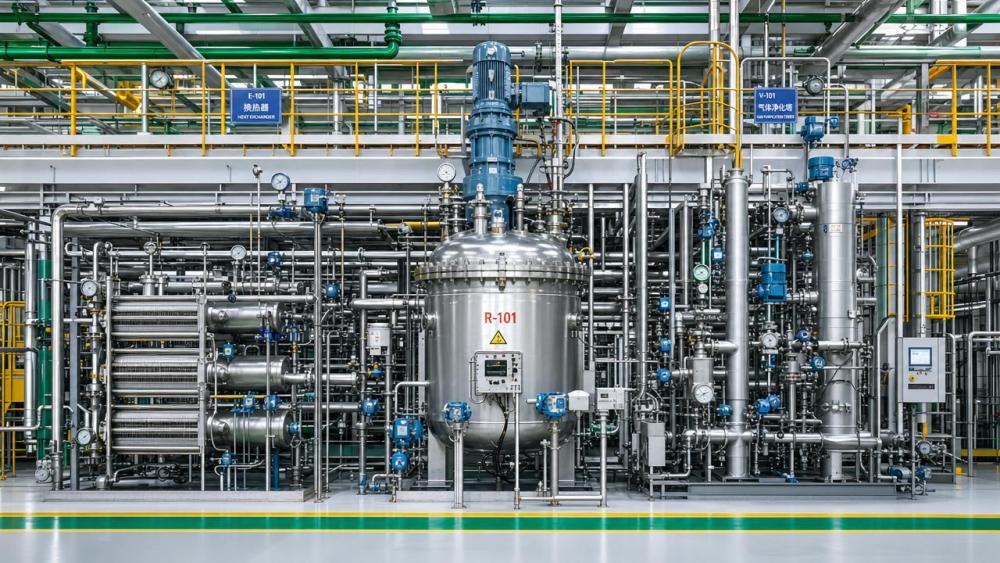
What is driving the change
- Higher energy costs are pushing tighter heat and utility control.
- Stricter compliance rules demand faster detection of abnormal operating states.
- More complex plants create more hidden interaction between units.
- Older assets need digital support to extend safe operating life.
- Carbon reduction targets require fewer losses and fewer unplanned shutdowns.
Why faster fault detection now matters more
In large petrochemical complexes, a small deviation in feed composition can affect cracking severity, product quality, and furnace stability at the same time. In coal-based synthesis, gas cleanup and pressure control are tightly linked, so one weak signal may mask a broader risk. Chemical process intelligence helps identify these chain reactions early.
The same logic applies to specialty gas refining and pressure swing adsorption units. When purity slips, the root cause may sit in a valve, a bed, a sensor, or an upstream fluctuation. Faster fault detection reduces the time spent guessing and improves the chance of corrective action before product off-specification spreads.
Typical fault patterns seen in practice
The business impact is broader than maintenance
Chemical process intelligence affects production planning, energy efficiency, and compliance readiness. When fault detection is earlier, operators can isolate the issue before it spreads to adjacent units. That lowers restart costs and protects margin in energy-intensive plants.
It also supports strategic decisions. For example, recurring fouling can justify exchanger redesign, while repeated valve oscillation may point to control tuning gaps. Over time, the intelligence layer helps separate one-off noise from structural weakness.
Who feels the effect first
- Operations teams gain earlier warning and clearer event context.
- Reliability teams can prioritize assets by fault likelihood.
- Process engineers can validate root causes with less manual review.
- Energy teams can trace hidden losses in heat and utility systems.
What to watch when building chemical process intelligence
The strongest programs combine historian data, process models, and domain rules. That matters because fault detection in chemical plants is rarely a single-variable problem. A good system must understand normal operating envelopes, startup transitions, shutdown behavior, and batch-to-batch variation.
It should also be explainable. If a model flags an anomaly but cannot show which variables changed first, trust drops quickly. In process industries, clear evidence is often more valuable than a high-confidence score.
- Data quality and sensor health must be checked first.
- Model alerts should align with process logic, not just statistics.
- Alarm flooding should be reduced, not amplified.
- Root-cause workflows must be simple enough for daily use.
Practical response paths for faster fault detection
A useful rollout often starts with high-value bottlenecks: furnaces, compressors, exchangers, reactors, and gas separation units. These areas create the fastest return because their deviations affect both output and safety.
Next, plants should define decision rules for alert severity, escalation timing, and response ownership. Chemical process intelligence works best when insights connect directly to action, not just dashboards.
The next advantage will belong to integrated operations
The next phase of chemical process intelligence is not only about finding faults faster. It is about linking process behavior, equipment condition, and energy performance in one decision layer. That is especially important for complex assets such as ASU cold boxes, hydrocracking trains, and large heat exchanger networks.
As plants pursue lower carbon intensity and higher reliability, the value of early detection will keep rising. The winners will be the sites that turn intelligence into a routine operating habit, not a one-time digital project.
If you are reviewing your current monitoring stack, start by asking one question: can the plant detect abnormal behavior before it becomes a loss event? If the answer is unclear, chemical process intelligence is the next practical step.