
Search
Category
Related Industries
- When should you hire a reaction engineering consultant?When should you hire a reaction engineering consultant? Discover the key decision points for scale-up, safety, design reviews, and troubleshooting.
- Pupuk Kaltim Licenses Topsoe Technology for Low-Carbon Ammonia ProjectPupuk Kaltim licenses Topsoe’s SynCOR Ammonia technology for its planned Fakfak complex. Discover how the project aims to reduce gas use and emissions.
- How does coal quality affect gasifier selection in Southeast Asia?Choosing coal gasification systems Southeast Asia projects can rely on? Explore how moisture, ash and reactivity shape gasifier selection and plant performance.
Weekly Insights
Stay ahead with our curated technology reports delivered every Monday.
Which Materials Are Best for High-Pressure Hydrogen Service?




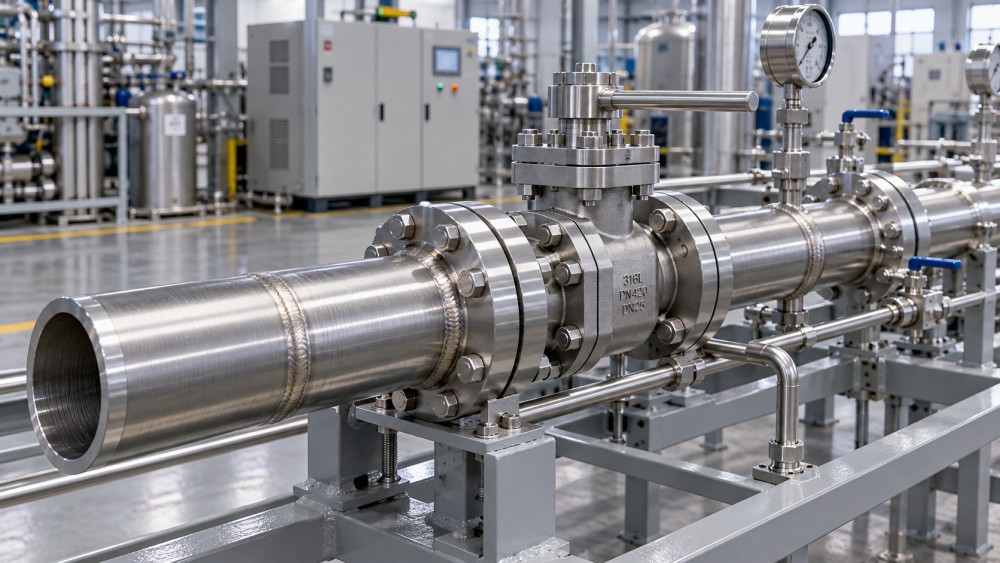
For many near-ambient-temperature, high-pressure hydrogen systems, solution-annealed 316L austenitic stainless steel is a strong starting candidate. Its relatively stable austenitic structure, ductility, and weldability support its use in piping, valves, and pressure-containing components. It still requires qualification for the actual hydrogen pressure, temperature range, stress level, and pressure-cycle history.
Hot hydrogen reactors require a different selection approach. Chromium-molybdenum steels are established candidates where resistance to high-temperature hydrogen attack governs, while selected nickel alloys address particular combinations of temperature, corrosion, and strength. Carbon steel also serves some hydrogen applications within a demonstrated operating envelope. The best material of construction therefore follows from the damage mechanism and component design, rather than pressure alone.
Which service conditions change the material choice?
Hydrogen pressure affects hydrogen uptake and crack behavior, but a pressure rating does not establish hydrogen compatibility. Two components operating at the same pressure can require different materials when one remains under steady load and the other experiences frequent filling, unloading, or thermal transients.
The service definition needs to include minimum and maximum metal temperatures, hydrogen partial pressure, gas composition, pressure-cycle range, anticipated cycle count, and the presence of water or corrosive contaminants. Startup, shutdown, depressurization, and upset conditions belong in that definition. A normal operating temperature alone can conceal a colder transient that controls fracture resistance.
Gas composition deserves particular attention. A dry, purified hydrogen stream presents different corrosion conditions from hydrogen containing moisture, sulfur compounds, chlorides, or process carryover. Impurities can alter surface reactions and hydrogen entry. Their effects are chemistry-specific, so contamination should never be treated as a dependable way to suppress embrittlement.
Hydrogen embrittlement and high-temperature hydrogen attack require different answers
Hydrogen embrittlement describes degradation associated with hydrogen interacting with a stressed material. Relevant consequences include reduced ductility, lower fracture resistance, and faster fatigue-crack growth. The component does not need to show obvious general corrosion. A small defect near a weld, thread root, or machining mark can become important under sustained or repeated loading.
High-temperature hydrogen attack, or HTHA, involves a different process. At elevated temperatures, hydrogen reacts with carbon in susceptible steels, producing methane and causing internal damage, including decarburization and fissuring. Temperature, hydrogen partial pressure, exposure time, and carbide stability influence susceptibility. Chromium and molybdenum additions improve resistance by stabilizing carbides, although each steel still has service limits.
A steel selected against HTHA is not automatically qualified for hydrogen-assisted fatigue at lower temperatures. Likewise, favorable embrittlement behavior in a stainless steel does not establish acceptable creep strength for a hot reactor. Where equipment moves through several temperature regimes, the assessment must address the mechanisms relevant to each regime.
How do the main material families compare?
These are candidate families, not interchangeable specifications. Material form also matters: plate, seamless tube, forging, casting, and weld metal can have different microstructures and defect populations even when associated with the same nominal alloy family.
Why is 316L often preferred, and where does that preference stop?
316L combines useful corrosion resistance with an austenitic structure that is relatively stable during deformation. Stable austenite generally offers better resistance to hydrogen-assisted degradation than many high-strength ferritic or martensitic structures. The low carbon content also helps limit sensitization during welding, but the “L” designation alone does not guarantee hydrogen compatibility.
The delivered condition matters. Heavy cold work raises strength and changes the microstructure, potentially reducing the margin against hydrogen-assisted cracking. A cold-drawn tube and a solution-annealed forging therefore need separate consideration, even if both carry a 316L designation. Local deformation introduced during bending, forming, or assembly also belongs in the assessment.
Compared with 316L, 304L generally has less stable austenite and a greater tendency to form martensite under deformation, especially at lower temperatures. That distinction supports choosing 316L as an initial candidate for many demanding gaseous-hydrogen applications. It does not establish that every 304L component is unsuitable or every 316L component is acceptable.
For a heavily cycled fitting or valve body, relevant evidence includes hydrogen-environment fracture and fatigue behavior in a representative material condition. An air tensile test and a chemical composition certificate provide useful information, but they do not answer how a crack will grow during repeated hydrogen pressurization.
When are carbon steel and chromium-molybdenum steel appropriate?
Carbon steel remains a practical option where the design accounts for its hydrogen behavior and operating conditions. Its use requires attention to strength level, toughness, defects, weld hardness, and cyclic loading. Increasing strength to reduce wall thickness can introduce greater susceptibility to hydrogen-assisted cracking in many ferritic steels. The resulting design needs reassessment rather than a simple allowable-stress substitution.
Thickness also changes the evaluation. A thick pressure boundary introduces through-thickness property variation, welding constraints, and inspection demands. Relevant fracture data should represent the actual product form and heat treatment. Base-metal properties alone cannot establish the performance of the complete welded component.
For elevated-temperature hydrogen service, chromium-molybdenum steels provide greater HTHA resistance than plain carbon steel. Selection uses established hydrogen-service guidance together with the applicable construction rules, service history, and operating envelope. Hydrogen partial pressure is central to this assessment; total process pressure alone is insufficient.
Stainless weld overlay or cladding can provide corrosion resistance on the process side, but it should not automatically be credited with protecting a susceptible substrate against HTHA. Hydrogen can reach the underlying pressure-bearing steel. The substrate needs its own assessment, and the overlay introduces additional considerations around bonding, thermal cycling, and disbonding during cooldown.
Are nickel alloys or very high-strength steels better?
A nickel alloy can be appropriate when stainless steel cannot meet a combined corrosion, temperature, and mechanical requirement. However, “nickel alloy” covers materials with very different hydrogen responses. Selected solid-solution-strengthened grades have useful applications, while some precipitation-hardened grades are susceptible to hydrogen-assisted cracking. Strengthening condition and heat treatment can change the result substantially.
The same caution applies to high-strength steels used in compact pressure components. Higher tensile strength improves load capacity, but it does not establish resistance to hydrogen-assisted fracture. Hard regions, sharp stress concentrations, and manufacturing defects become especially consequential when the material has limited tolerance for hydrogen.
Substitution therefore requires evidence for the proposed grade, strength condition, and environment. A corrosion-resistance chart or room-temperature strength comparison cannot justify changing a hydrogen pressure boundary to a stronger alloy.
What can fabrication change after the alloy is selected?
Welding creates a joint with several distinct material regions: weld metal, the heat-affected zone, and unaffected base metal. In ferritic steels, local hardening can increase cracking susceptibility. In stainless steels, filler selection, weld microstructure, and residual stress affect performance. Qualification needs to address these regions rather than treating the weld as identical to the parent material.
Heat treatment must follow the selected material and construction requirements. Where post-weld heat treatment is required, its effectiveness depends on the actual thermal cycle and section geometry. It does not erase every defect or guarantee hydrogen resistance. Unqualified heat treatment can also impair properties that the original material specification was intended to establish.
Surface preparation and geometry influence where damage begins. Thread roots, abrupt section changes, deep tool marks, and poorly finished intersections concentrate stress. A highly polished surface cannot compensate for unsuitable metallurgy, but avoiding severe surface defects reduces potential crack-initiation sites. Forming and machining records are especially relevant where they reveal substantial cold work.
Electroplating, pickling, and other manufacturing processes can introduce hydrogen before the equipment enters service. This matters particularly for susceptible high-strength parts such as fasteners and springs. Internal trim and external load-bearing hardware therefore need their own material assessment; the body alloy does not qualify the entire assembly.
Which evidence turns a candidate alloy into a defensible selection?
The most useful evidence connects material properties to the component’s actual failure modes. For a frequently cycled hydrogen component, fatigue-crack-growth data in hydrogen can be more informative than elongation measured in air. For a pressure boundary containing an assumed flaw, hydrogen-environment fracture resistance helps establish the acceptable flaw size and loading envelope.
Test conditions need to represent the factors that control behavior. Relevant differences include hydrogen pressure, temperature, material strength, weld condition, loading rate, and cycle frequency. Slower loading can give hydrogen more time to interact with a crack tip, so a rapid laboratory test should not automatically be treated as conservative for slow service cycles.
A useful material qualification package brings together:
- A defined service envelope: normal operation, pressure cycling, temperature excursions, and credible gas-composition changes.
- Traceable material condition, including product form, heat treatment, strength, and significant cold work.
- Evidence for the governing mechanisms. Hydrogen-assisted fracture and fatigue require different supporting information from HTHA, creep, or process corrosion.
- Fabrication and inspection requirements that connect allowable defects, weld quality, and component geometry to the design assessment.
For example, a solution-annealed 316L line carrying dry hydrogen near ambient temperature starts from a different selection basis than a hot chromium-molybdenum reactor shell or a compact, rapidly cycled high-strength fitting. Each needs evidence matched to its limiting mechanism. A material substitution becomes defensible when that evidence covers the proposed component, manufacturing condition, and operating envelope.