
Search
Category
Related Industries
- How slag viscosity affects entrained flow gasifier performanceDiscover how slag viscosity affects entrained flow gasifier drainage, efficiency, and wall durability—and learn what to evaluate for more reliable operation.
- How to assess oversupply risk with olefins market intelligenceUse olefins market intelligence to assess oversupply risk through capacity, demand, costs, and trade flows. Discover how to strengthen procurement and investment decisions.
- How grid bottlenecks shape energy infrastructure investment in EuropeExplore energy infrastructure Europe can rely on: discover how grid bottlenecks, connection risks and storage economics shape investment decisions and project value.
Weekly Insights
Stay ahead with our curated technology reports delivered every Monday.
How to Prioritize a Process Equipment Upgrade Without Disrupting Output




When a reactor feed pump begins showing seal failures, a heat exchanger loses thermal margin, or an analyzer becomes unreliable, the obvious response is to replace it. The harder question is whether the equipment should be upgraded now, during the next planned outage, or through a temporary mitigation that protects production until a better window is available. In a high-utilization process unit, choosing the wrong timing can turn a sensible reliability investment into an avoidable rate reduction, quality deviation, or startup risk.
The practical answer is to prioritize a process equipment upgrade by separating urgency from importance. An asset should move ahead in the queue when its credible failure consequence is high, its condition is deteriorating faster than the next safe intervention window, and the work can be isolated or staged without creating greater operating risk. A larger theoretical efficiency gain does not automatically outrank a smaller upgrade that removes an immediate containment, safety, or production vulnerability.
Start with the decision that actually needs to be made
Equipment lists often mix very different needs: an obsolete control valve positioner, a corroding exchanger channel, a compressor anti-surge system nearing end of support, and a proposed reactor internals modification intended to improve conversion. Treating these as one capital ranking exercise creates confusion because they do not have the same failure mode, outage requirement, or operational consequence.
Before assigning priority, define the decision in operational terms:
- Does the equipment need intervention before the next planned shutdown?
- Can the work be performed online, at reduced rate, or only after full isolation and decontamination?
- What is the realistic consequence if no action is taken for one operating cycle?
- Is the proposed scope necessary to restore reliable service, or is it an optimization project that can wait?
- Will deferring the work make the later outage longer, more complex, or less safe?
This framing prevents a common error: ranking projects only by projected return while leaving failure exposure hidden inside maintenance notes. A moderate energy-saving upgrade may be valuable, but it should not displace an intervention where loss of containment, inability to meet a protection function, or a single-point production failure is becoming credible.
Build a priority view from condition, consequence, and recoverability
Asset condition alone is not enough. A pump with elevated vibration may have a manageable standby arrangement; an apparently healthy pressure transmitter may be critical because it is the only reliable input to a protective trip. Priority comes from the relationship between how likely an issue is and what operations can do when it occurs.
Use a short narrative beside any scoring method. Numbers can help compare candidates, but they can also hide assumptions. For example, assigning a low probability to exchanger failure because it has not leaked before is weak reasoning if inspection shows localized thinning at known vulnerable locations. The explanation behind the score should state the degradation mechanism, available evidence, safeguards, and expected operating exposure before the next intervention.
Distinguish “must do now” work from work that needs early preparation
Not every high-value upgrade should be installed immediately. Some should be prioritized for engineering, procurement, inspection, or site preparation long before they are prioritized for execution. This distinction is essential when output cannot be interrupted.
A control system migration may require months of logic review, simulator testing, cybersecurity checks, operator training, and cutover planning, while the physical installation may occur during a short shutdown. Likewise, replacing a high-pressure reactor component can demand material verification, welding procedures, cleaning plans, lifting studies, and pressure-test boundaries that must be settled before the outage begins. Delaying the field work may be acceptable; delaying the definition work may not be.
Separate each candidate into one of four practical paths:
- Immediate risk reduction: intervene before the next operating campaign because continued service is not adequately defensible.
- Outage-bound execution: freeze scope, procure critical materials, and perform the upgrade in the next planned shutdown.
- Online or phased modification: use a bypass, parallel train, spare skid, temporary instrumentation, or staged tie-in to reduce production impact.
- Monitor with explicit limits: defer only when condition is understood, operating limits are defined, monitoring frequency is increased, and a clear trigger requires escalation.
The fourth path is often misused. “Monitor” is not a decision unless it includes who reviews the data, which parameter matters, what threshold changes the plan, and whether spare parts or repair resources are available. A monitored deferral without a trigger is simply postponement.
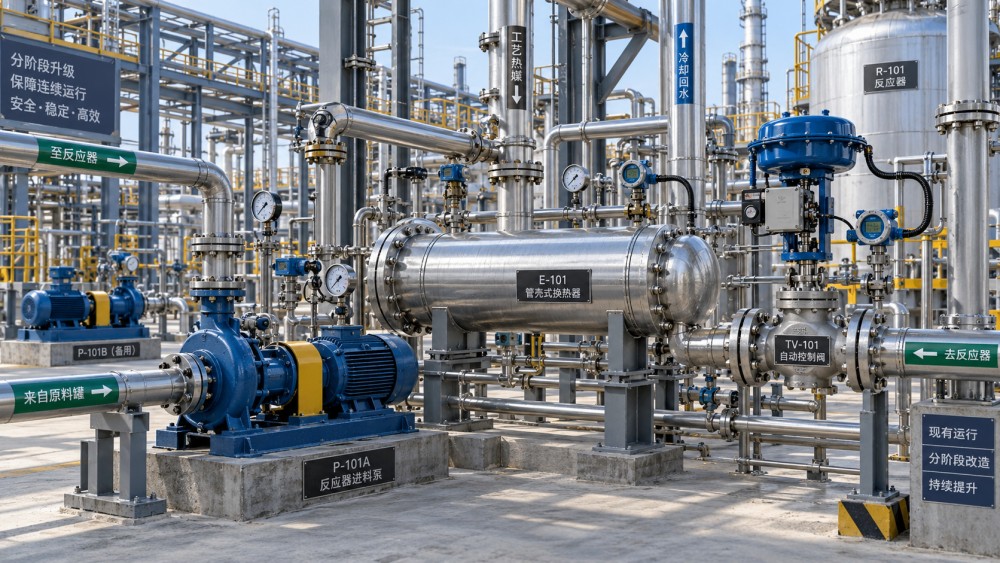
Test whether the proposed scope is larger than the problem
Scope growth is a frequent source of disruption. An equipment reliability issue can become attached to an attractive modernization package: new metallurgy, revised piping, upgraded automation, expanded capacity, and energy integration. The combined project may eventually be justified, but bundling every improvement into a single outage can turn a controlled intervention into a schedule-critical shutdown package.
Break the scope into functional layers. First identify the minimum work needed to restore safe, reliable duty. Then identify modifications needed to remove repeat failure mechanisms. Finally, identify performance improvements that are beneficial but not required for continued operation. This does not mean ignoring efficiency or decarbonization benefits; it means making their outage and commissioning demands visible.
For a heat exchanger, the minimum scope might be repairing a compromised channel or replacing a bundle. The repeat-failure scope may include correcting flow distribution, tube material selection, vibration exposure, or cleaning access. A wider optimization scope could include revising the heat integration scheme or adding controls to stabilize approach temperature. Each layer has a different design maturity requirement and risk to the maintenance window.
Questions that expose hidden scope risk
- Does the new equipment have the same hydraulic, thermal, electrical, control, and structural interfaces as the existing item?
- Will the change alter relief scenarios, pressure drop, dead-leg conditions, catalyst behavior, or material compatibility?
- Are there tie-ins that cannot be verified until the unit is opened?
- Will commissioning require process fluids, utility conditions, or operating modes that are not available during normal startup?
- Can the old configuration be restored if startup problems occur, or does the work create a one-way cutover?
Where answers are uncertain, prioritize front-end verification. Laser scans, thickness mapping, control narrative reviews, vendor document checks, and isolation walkdowns may not look like production work, but they are often what protects the production schedule later.
Plan around the operating window, not around an ideal project sequence
A conventional project plan moves from design to procurement, installation, and startup. In operating facilities, the critical path often runs in the opposite direction: begin with the next achievable intervention window, then work backward to determine what must be frozen, purchased, reviewed, and rehearsed before that date.
Start by mapping constraints that operations cannot easily move. These may include feed commitments, seasonal utility limitations, catalyst cycle timing, shared flare or steam-system work, inspection requirements, major turnaround boundaries, and availability of specialized crews. Then identify the smallest outage envelope in which the upgrade can be safely executed.
A short production reduction may be preferable to a full shutdown when the equipment is non-isolated from the main process but can be bypassed with a temporary arrangement. Conversely, forcing online work to avoid a shutdown can be a poor choice if it increases simultaneous operations, introduces temporary hoses or jumpers into hazardous service, or makes testing incomplete. The goal is not zero downtime at any cost. The goal is the lowest total operational risk for the required outcome.
Protect output through staging and commissioning discipline
Most disruptions occur at interfaces: the first energization of a motor, the first control loop placed in automatic, the first introduction of process fluid, or the first transition from recirculation to normal throughput. Installation completion should therefore not be treated as readiness for production.
For each upgrade, define a staged return-to-service plan before field work starts. It should identify mechanical completion boundaries, inspection holds, cleaning and flushing requirements, instrument loop checks, pressure testing, rotation checks, permissives, alarm and trip verification, and the conditions required before introducing hazardous or valuable inventory. The sequence needs clear ownership across operations, maintenance, engineering, inspection, and control-system personnel.
High-pressure and high-temperature equipment deserves particular caution. A replacement component that fits physically may still behave differently because of wall thickness, metallurgy, heat-up limits, insulation arrangement, thermal expansion, or nozzle loads. A reactor internals change may affect pressure drop, distribution, temperature response, and catalyst loading procedures. These are not reasons to avoid the upgrade; they are reasons to prevent a rushed startup from becoming the first time the design is tested as a system.
Use a readiness review focused on failure to return to rate
Rather than asking only whether all work orders are complete, ask what could prevent stable output after startup. Review spare parts for the upgraded equipment, temporary bypass removal, outstanding punch items, control fallback arrangements, vendor attendance where needed, operating procedures, sampling plans, and the availability of utilities at each startup stage. A minor outstanding item may be acceptable; an untested shutdown input or inaccessible isolation point is not.
It is also useful to define a controlled fallback position. This might be a reduced-rate operating envelope, operation on a parallel train, or a safe recirculation condition while performance is confirmed. Fallback does not replace proper pre-startup checks, but it reduces pressure to force equipment to full duty before trends are understood.
Make deferral decisions visible and reversible
Some upgrades will reasonably be deferred because condition is stable, redundancy exists, or the required scope would disrupt a more critical production period. The decision should be recorded with the basis for deferral, the assumed operating period, required monitoring, and the event that invalidates the decision. This matters especially where temporary repairs have accumulated. A clamp, bypass, manual reading route, or operating restriction can be acceptable for a defined period, but it should not quietly become the permanent design.
Review deferred items after meaningful changes: an unexpected trip, a new inspection result, a throughput increase, feedstock change, loss of a standby asset, or a revision to the next shutdown schedule. These changes alter the original risk balance. A disciplined review may move an item from “next outage” to “prepare now,” even when immediate installation remains unnecessary.
When should an efficiency upgrade wait?
An efficiency project can wait when it has no near-term safety, integrity, compliance, or reliability driver; when its expected benefits depend on uncertain operating assumptions; or when installation would consume a scarce outage window needed for higher-consequence work. It should still receive enough engineering attention to preserve a future option, particularly when long-lead equipment or tie-in studies are involved.
Is redundant equipment automatically low priority?
No. Redundancy reduces exposure only when the standby equipment is proven available, can carry the required duty, and does not share the same failure mechanism, utility dependency, or common discharge and suction constraints. A nominal spare train with unresolved vibration, limited capacity, or difficult changeover may provide far less protection than the equipment register suggests.
What is the clearest sign that an upgrade has been scheduled too late?
The clearest sign is when the team is relying on unverified assumptions to reach the next outage: uncertain remaining wall thickness, repeated temporary repair, unavailable critical spares, growing process instability, or an operating restriction with no defined trigger for shutdown. At that point, the immediate priority may be to reduce uncertainty and prepare contingency actions, not simply to defend the existing schedule.