
Search
Category
Related Industries
- How slag viscosity affects entrained flow gasifier performanceDiscover how slag viscosity affects entrained flow gasifier drainage, efficiency, and wall durability—and learn what to evaluate for more reliable operation.
- How to assess oversupply risk with olefins market intelligenceUse olefins market intelligence to assess oversupply risk through capacity, demand, costs, and trade flows. Discover how to strengthen procurement and investment decisions.
- How grid bottlenecks shape energy infrastructure investment in EuropeExplore energy infrastructure Europe can rely on: discover how grid bottlenecks, connection risks and storage economics shape investment decisions and project value.
Weekly Insights
Stay ahead with our curated technology reports delivered every Monday.
Evaluating Delivery and Documentation Risks in EPC Turbine Procurement




Why delivery and documentation risks deserve equal attention
A turbine package can appear commercially sound when the quoted price, guaranteed output, and delivery date align with the project schedule. Yet in EPC procurement, many of the most expensive problems emerge after award: a late approved drawing holds up civil work, a missing material certificate delays release, an interface mismatch reaches site, or a shipment arrives before the consignee is ready to receive it.
For procurement teams, turbine risk is rarely limited to whether the manufacturer can build rotating equipment. The more practical question is whether the supplier, EPC contractor, freight parties, inspection personnel, and owner’s engineering team can manage a controlled sequence of technical information, manufacturing records, inspections, packing, and handover. A steam turbine, generator, condenser connection, lube-oil skid, control system, and auxiliary drives may be supplied under different scopes. A gap in responsibility between those scopes can become a delay in construction or commissioning.
This is particularly relevant for industrial thermal power projects, where the steam system may be designed around process demand rather than only grid output. Extraction pressure, inlet steam quality, start-up arrangements, bypass capacity, and process-steam availability can all affect the final turbine configuration. Procurement should treat the turbine package as an integrated plant interface, not as a stand-alone machine purchase.
Delivery risk begins before the manufacturing schedule
Delivery dates are often discussed as one line in a purchase order: “delivery within X weeks after contract effectiveness.” That wording is rarely sufficient for a complex turbine package. The date may depend on approved drawings, receipt of owner-furnished data, advance payment, technical clarification closure, or an agreed inspection plan. If those dependencies are not explicitly recorded, parties may later disagree about when the delivery clock started.
A more useful approach is to separate the contractual delivery date from the package’s internal milestone path. Procurement personnel should request a schedule that identifies, at minimum:
- design-data freeze and issue of general arrangement drawings;
- approval dates for foundation loads, nozzle loads, piping orientation, electrical single-line diagrams, and control interfaces;
- long-lead material release points, especially for forgings, blades, rotors, generator components, and control hardware;
- planned witness, hold, and review points for inspections and tests;
- readiness dates for preservation, packing, dispatch, and shipment documentation;
- site delivery, unloading, storage, erection support, and commissioning handover boundaries.
The critical path is not necessarily the machining of the turbine rotor. A late decision on gland-steam arrangements, a revised process-steam extraction requirement, or a change in the project electrical protection philosophy can reopen engineering that appeared complete. Procurement should ask which inputs are “no later than” dates, what happens when they are missed, and whether the supplier’s quoted lead time assumes a clean approval cycle.
For cross-border supply, the agreed trade term also changes who controls key stages of the shipment. Incoterms® 2020 rules distinguish delivery, risk transfer, carriage, export and import responsibilities, but they do not replace a detailed packing, notification, and document-release procedure. The International Chamber of Commerce emphasizes that parties must select the rule and named place carefully for the transaction involved. [1] In practice, a procurement team should identify the exact delivery point, who books transport, which party insures the cargo, and when the buyer receives packing data needed for site preparation.
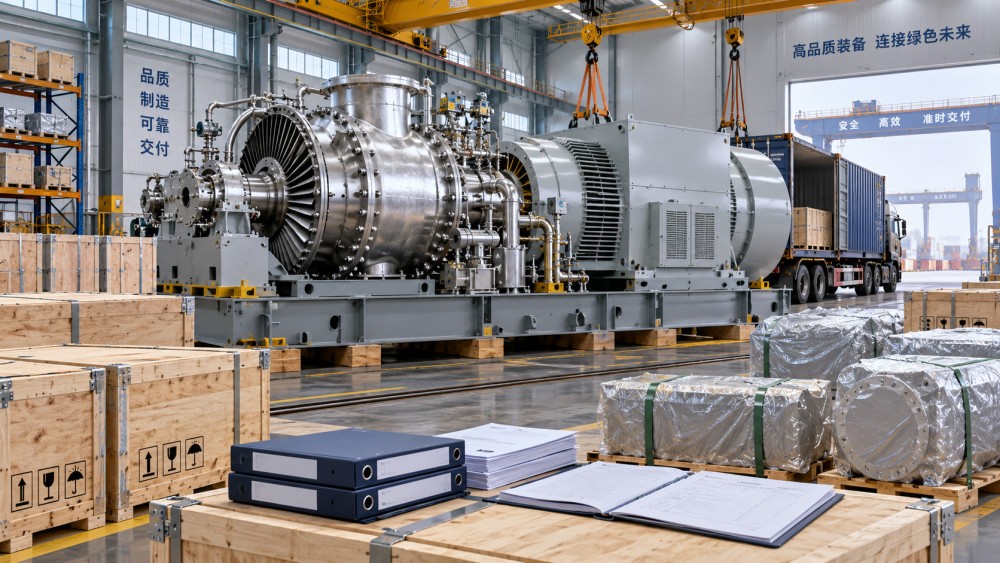
Documentation is a project control system, not an administrative appendix
Document delays can stop work even when equipment is physically available. Civil contractors may need certified foundation loads and anchor-bolt information before pouring concrete. Piping designers need nozzle coordinates, allowable loads, steam conditions, drain points, and insulation limits. Electrical teams need motor lists, generator characteristics, cable schedules, earthing requirements, and protection interfaces. Commissioning teams need operating logic, interlock narratives, lubrication instructions, and preservation requirements before site activities begin.
Documentation risk is highest when the contract uses broad labels such as “complete documentation” without defining content, issue dates, format, review status, or language. A document register should convert that vague obligation into a tracked deliverable list. Each item should state its purpose, responsible party, required revision, planned submission date, review period, and whether approval is required before the next manufacturing or construction activity.
ISO 9001:2015 addresses the control of documented information within a quality management system, including availability, protection, version control, retention, and prevention of unintended use of obsolete documents. [2] Procurement need not turn a turbine order into an ISO audit, but these control principles are practical. An approved-for-construction drawing should be identifiable as such. Superseded revisions should not remain in circulation at the site. A supplier transmittal should show exactly what has changed rather than forcing reviewers to compare large drawing packages manually.
Documents that commonly carry hidden schedule exposure
Not every late document has the same consequence. Buyers can prioritize review effort by distinguishing between interface-critical documents and records that are mainly needed for final handover.
A late manufacturing record may not affect the erection sequence immediately, but it can still prevent final acceptance or payment. Conversely, an early but technically incorrect interface drawing can create more damage than a late record. Procurement should therefore assess documents by downstream dependency, not merely by the number of overdue submittals.
Align the turbine package with steam-system decisions
Industrial owners frequently face a planning tension: the turbine should use available steam efficiently, but the steam system must also remain stable when process demand changes, a boiler trips, or the turbine is unavailable. Procurement documents should avoid treating rated turbine output as the only defining criterion. The package must be evaluated against the steam balance that the plant can actually sustain.
Relevant questions include whether inlet conditions are fixed or variable; whether extraction steam is controlled or uncontrolled; whether a bypass station can maintain process supply during turbine outages; whether condensate return quality affects cycle chemistry; and how frequently the unit will start, stop, or operate at reduced load. A turbine optimized around a narrow design point may not be commercially suitable if the owner expects wide process variation or frequent operation away from the guarantee point.
At this stage, coordinated power plant EPC support is relevant because turbine selection, steam-system interfaces, auxiliary equipment, and project execution documents need to be reviewed as connected responsibilities. The useful procurement question is not whether every service sits in one contract; it is whether the scope matrix makes each engineering and delivery interface visible before fabrication and site work proceed.
For performance guarantees, the test basis should be explicit. Steam pressure, temperature, exhaust conditions, extraction flows, auxiliary power treatment, allowable measurement uncertainty, and correction methods can materially affect the comparison between contractual and tested performance. ASME PTC 6 provides procedures for performance testing of steam turbines and is commonly referenced when parties need a defined test framework. [3] If a project uses another standard or a bespoke guarantee method, the contract should identify it clearly and reconcile it with the plant’s actual operating envelope.
Where procurement controls often fail
One recurring weakness is accepting a supplier schedule without checking its logic. A bar chart may show an impressive dispatch date while concealing that machining begins before final approval of critical interfaces. Another weakness is allowing technical comments to circulate through email without a formal disposition register. When a question about a drain connection, instrument range, or terminal-box orientation is answered informally, the response may never reach the controlled drawing set.
Inspection planning can also be too generic. A quality plan should state which steps are hold points, witness points, review points, or supplier notifications; who has release authority; what records must be available; and how nonconformities are closed. ISO 10005:2018 gives guidance on quality plans and describes their use in specifying activities, resources, and controls for a particular project or contract. [4] That concept is directly useful for complex turbine procurement, even where the parties use their own project quality procedures.
Shipment readiness deserves the same discipline. A “ready for dispatch” notice should not merely confirm that crates exist. It should be supported by equipment identification, packing lists, weights and dimensions, lifting points, preservation status, dangerous-goods information where applicable, document status, and confirmation that outstanding punch-list items do not affect transport or installation. Large components may require route surveys, special lifting equipment, or temporary storage arrangements. If this information arrives after the cargo is booked, logistics costs and site disruption can escalate quickly.
A practical procurement review before release to manufacture
Before authorizing full manufacture, the buyer’s team can conduct a focused readiness review. The purpose is not to repeat the bid evaluation; it is to confirm that commercial commitments can now be executed through controlled technical and documentary processes.
- Freeze the scope boundary. Identify supplied equipment, excluded equipment, owner-furnished items, site services, and responsibility for every mechanical, electrical, controls, and civil interface.
- Approve the document register and schedule together. A document schedule without links to manufacturing and construction milestones has limited value.
- Test the steam balance against normal and upset conditions. Confirm that the selected turbine arrangement reflects expected inlet conditions, extraction demand, bypass philosophy, and operating flexibility.
- Define acceptance evidence. List required inspections, factory tests, certificates, manuals, software backups where relevant, preservation records, and final dossier contents.
- Set escalation rules. Agree how overdue documents, technical deviations, nonconformities, and schedule impacts will be reported and resolved.
- Plan the handover period. Define the transition from factory release to transport, storage, erection, commissioning support, and warranty administration.
Contract forms may allocate risk differently, particularly where the EPC contractor assumes broad responsibility for plant completion. The FIDIC EPC/Turnkey Contract, commonly known as the Silver Book, is one example of a published contract model used for turnkey arrangements, but its suitability depends on the project’s risk allocation and the completeness of employer requirements. [5] Procurement teams should not assume that a turnkey label eliminates the need for detailed package controls. Unclear input data and poorly defined interfaces remain difficult to manage under any contract structure.
Use evidence, not reassurance, to judge execution readiness
Early supplier meetings often produce confident statements about production capacity, document turnaround, and delivery control. Procurement decisions are stronger when those statements are translated into evidence: a resource-loaded schedule, a named document-control process, inspection checkpoints, traceability procedures, a packing plan, and an interface matrix that identifies open inputs. Where a supplier cannot yet provide final records, it can still show the process by which those records will be generated, reviewed, and retained.
The central lesson is straightforward. Turbine procurement risk is created at the intersections between equipment design, steam-system planning, document control, quality release, and logistics. Price and rated output remain important, but they do not show whether the package can move through engineering, construction, and commissioning without avoidable interruption. Buyers who make delivery dependencies and documentation obligations visible before manufacture are better positioned to resolve issues while options remain available.
Sources
[1] International Chamber of Commerce, Incoterms® 2020, ICC Publishing, 2019.
[2] International Organization for Standardization, ISO 9001:2015 — Quality management systems — Requirements, Clause 7.5, 2015.
[3] ASME, PTC 6 — Steam Turbines, Performance Test Code.
[4] International Organization for Standardization, ISO 10005:2018 — Quality management — Guidelines for quality plans, 2018.
[5] FIDIC, Conditions of Contract for EPC/Turnkey Projects, Second Edition, 2017.