
Search
Category
Related Industries
- Chinese Researchers Use Metal-Free Molecular Sieves for Olefin CarbonylationMetal-free molecular sieves enable olefin carbonylation. Discover how Chinese researchers’ approach could simplify catalyst separation in oxygen-containing chemical synthesis.
- What determines the purchase cost of coal chemical plant equipment?Coal chemical plant equipment costs depend on design, materials, supplier scope, and delivery terms. Discover how to compare quotes, uncover hidden costs, and make smarter purchases.
- Asahi Kasei Secures Third-Party Assurance for Acrylonitrile Carbon FootprintAsahi Kasei secures third-party assurance for its acrylonitrile carbon footprint. Discover what verified emissions data means for supply chain transparency and supplier assessments.
Weekly Insights
Stay ahead with our curated technology reports delivered every Monday.
Are Standards for Asia-Sourced Offshore Drilling Equipment Reliable?




As offshore projects move into deeper water, higher pressures, and less forgiving weather windows, procurement teams increasingly ask: Are there reliable standards for offshore drilling equipment sourced from Asia? The practical answer is yes—but reliability cannot be inferred from geography, a factory brochure, or a certificate scanned into a bid package. It must be demonstrated through a chain of evidence: applicable design codes, material traceability, competent engineering review, controlled fabrication, independent witnessing, and service support after installation.
Asia is home to a large and diverse offshore supply base. Equipment may be designed, machined, assembled, or tested in China, Singapore, South Korea, India, Malaysia, Japan, and other regional manufacturing centers. Some facilities are deeply integrated into global oilfield supply chains; others may have limited experience with the specific duty cycle, regulatory environment, or documentation discipline required by offshore operations. The procurement question, therefore, is not “Asia or elsewhere?” It is whether a particular supplier and product meet the project’s required technical, safety, and verification standard.
For operators, drilling contractors, EPC firms, and insurers, this distinction matters. A failure in a high-pressure manifold, blowout preventer component, lifting system, mud pump, or control panel is not simply a warranty event. It can become a well-control, personnel-safety, environmental, or extended-downtime event. The right assessment framework should be as rigorous as the operating environment.
Standards exist—but the specification must come first
Offshore drilling equipment is not governed by one universal rulebook. The standards that apply depend on what the equipment does, where it will operate, the governing jurisdiction, the rig classification arrangement, and the operator’s own engineering requirements. A reliable supplier should be able to map each supplied item to the relevant codes rather than offering a vague statement that products are “made to international standard.”
For example, commonly referenced frameworks may include API standards for drilling and well-control equipment, ISO standards for quality and risk management, IEC requirements for electrical and hazardous-area systems, and class-society rules issued by organizations such as DNV, ABS, Lloyd’s Register, or Bureau Veritas. NORSOK requirements may also influence projects tied to Norwegian practices or North Sea operating expectations. Depending on the item, relevant references may include API 16A for drill-through equipment, API 16C for choke and kill systems, API 16D for control systems, API 8C for drilling and production hoisting equipment, and API 16R for marine drilling riser equipment.
Those references are starting points, not automatic proof of suitability. A purchase order must still define design pressure, temperature range, fluid composition, sour-service exposure, fatigue duty, seismic or motion loads where relevant, corrosion allowance, electrical classification, required redundancy, documentation language, and acceptance criteria. Without this level of definition, even a product manufactured “to API” may not be appropriate for the intended well or rig.
What makes an Asia-sourced offshore equipment package trustworthy?
The most dependable packages tend to share a visible pattern: the supplier does not resist scrutiny. It provides drawings, calculations, inspection plans, qualification records, traceability files, and access to production milestones. It accepts that offshore buyers need to verify what is behind the finished coating and nameplate.
A useful way to evaluate reliability is to examine five connected layers.
1. Engineering capability and code interpretation
Manufacturing competence begins well before steel is cut. The supplier should demonstrate that its engineering team understands the governing code edition, project specifications, interface loads, and operational limitations. For pressure-containing equipment, this may involve pressure-boundary calculations, flange and connection compatibility, valve sizing, relief philosophy, and material selection. For rotating or lifting equipment, it can include load paths, fatigue considerations, brake performance, mechanical protection, and emergency operating modes.
Ask for a compliance matrix that identifies every applicable clause, the supplier’s means of compliance, and the evidence that will be delivered. This simple document often reveals whether a vendor has genuinely engineered the package or merely adapted an earlier design. It also helps prevent a recurring offshore problem: equipment that passes a factory test yet does not integrate cleanly with the rig’s controls, piping, structural supports, or maintenance procedures.
2. Material traceability from mill to finished component
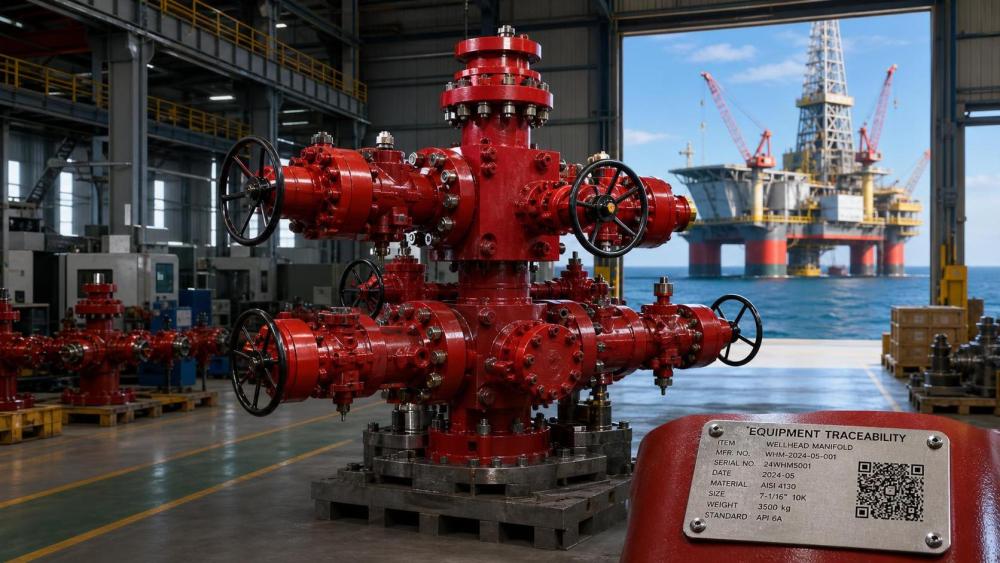
For high-pressure, low-temperature, corrosive, or sour-service duties, material traceability is central to reliability. A component can look flawless after machining while still carrying unacceptable risk if the actual alloy, heat treatment, or mechanical properties cannot be verified.
Buyers should require material test reports linked to heat numbers and part numbers, with a traceability method that survives cutting, welding, machining, and final assembly. Where the service requires it, chemical composition, tensile properties, impact performance, hardness limits, and corrosion-resistance requirements should be checked against the specification. Sour-service applications often require particular attention to ISO 15156/NACE MR0175 compatibility, hardness control, and welding procedures.
Documentation should not be treated as paperwork detached from the hardware. During inspection, the inspector should be able to select a physical component, identify its marking, and trace it back through the manufacturing record. If that chain breaks, confidence should fall sharply, regardless of the country of origin.
3. Controlled fabrication, welding, and testing
Reliable offshore fabrication relies on repeatable controls rather than individual craftsmanship alone. Review the supplier’s quality management system, but look beyond a generic ISO 9001 certificate. The deeper questions are operational: Are welding procedure specifications qualified for the actual materials and thicknesses? Are welders qualified for the required positions and processes? Is preheat controlled? Are post-weld heat-treatment records complete? How are nonconformities recorded and closed?
For critical welds and pressure boundaries, the inspection and test plan should define hold points, witness points, non-destructive examination methods, sampling scope, and acceptance standards. Depending on the equipment, this may include visual inspection, magnetic-particle testing, liquid-penetrant testing, ultrasonic testing, radiography, dimensional checks, hydrostatic testing, pressure cycling, functional testing, and leak testing.
A factory acceptance test is valuable, but it should reproduce meaningful operating logic rather than merely show that a component can be energized. For a control system, verify alarms, emergency shutdown sequences, redundancy switching, communications, fail-safe positions, and data logging. For a choke-and-kill assembly, verify pressure integrity, valve travel, connection alignment, instrumentation, and the availability of calibrated test equipment.
4. Independent verification and certification pathways
Third-party involvement can significantly strengthen confidence, especially for safety-critical equipment. However, buyers should be precise about what a certificate actually means. A certificate of conformity may cover a defined batch, a particular inspection activity, or a supplier quality system. It does not necessarily mean that a class society has approved the complete design for the intended installation.
Where class approval, type approval, product certification, or project certification is required, confirm the exact scope with the issuing body. Check the certificate number, validity, model designation, material range, operating parameters, manufacturing location, and any exclusions. A type approval for one configuration should not be assumed to apply to a modified pressure rating, control architecture, or alternate material grade.
Independent inspection agencies can also be engaged for source surveillance. Their role is most effective when they are involved early—reviewing the inspection and test plan, witnessing critical stages, and checking records as work proceeds. Bringing an inspector in only for the final hydrotest can leave too many earlier steps invisible.
A practical supplier due-diligence sequence
When evaluating Asia-sourced offshore drilling equipment, procurement teams benefit from a staged process rather than an all-or-nothing supplier judgment.
This approach also reduces the temptation to focus only on unit price. Lower acquisition cost can be meaningful, but it should be evaluated against inspection effort, schedule risk, spare-parts availability, documentation quality, and the cost of a delayed mobilization. In offshore work, a component that arrives on time but cannot be accepted can be more expensive than a higher-priced item delivered with a complete, auditable data package.
Common misconceptions that create avoidable risk
“API monogram equals full project approval.”
An API monogram or license can be an important indicator, but it does not replace review of the actual configuration, service conditions, purchaser specification, or class requirements. Confirm the current license status and the precise product scope covered.
“Third-party inspection eliminates the need for buyer involvement.”
Inspection agencies verify against the approved scope they are given. If the purchase specification is vague, the inspection scope may be vague as well. The buyer or EPC contractor must still establish the design basis, criticality ranking, and acceptance requirements.
“The final test is all that matters.”
A successful pressure test does not prove that materials were correct, welding was properly qualified, controls will function under real operating conditions, or fatigue life is adequate. Final testing is one layer of assurance, not the whole assurance case.
“Asia-sourced means one level of quality.”
The region contains world-class engineering manufacturers, capable subcontractors, trading companies, and facilities with uneven controls. Treat each supplier, factory, and product family individually. Even within one vendor group, different workshops may have different approval scopes and production discipline.
Documentation is part of the equipment
Offshore assets change hands, undergo audits, and operate for years after the original purchase team has moved on. That makes the manufacturing record book more than an administrative deliverable. It becomes the equipment’s memory.
A complete turnover dossier may include approved drawings, datasheets, calculations where required, material certificates, welding records, NDE reports, heat-treatment charts, pressure-test reports, calibration certificates, certificates of conformity, preservation records, operating manuals, spare-parts lists, and nonconformance closeout documentation. Digital files should be searchable, consistently indexed, and tied to equipment tags. A pile of unstructured PDFs is not the same as a usable lifecycle record.
This is an area where intelligence-led procurement can add real value. By following evolving environmental thresholds, class guidance, process safety expectations, and supply-chain conditions, engineering teams can update specifications before gaps become expensive. For complex equipment operating at the intersection of high pressure, corrosive chemistry, thermal cycling, and automation, standards monitoring should remain active through design, fabrication, commissioning, and maintenance planning.
FAQ: Are there reliable standards for offshore drilling equipment sourced from Asia?
Can offshore drilling equipment made in Asia meet international standards?
Yes. Equipment manufactured in Asia can meet API, ISO, IEC, class-society, and project-specific requirements when the supplier has the appropriate capability, approved processes, traceable materials, and independently verifiable testing. Manufacturing location alone does not determine compliance.
Which certifications should a buyer request?
Request certifications relevant to the equipment and project rather than a generic list. These may include applicable API licensing or monogram evidence, ISO quality-system certification, class or type approval where required, hazardous-area compliance for electrical equipment, material certificates, calibration certificates, and third-party inspection reports. Verify the scope and validity of every document.
Is a factory audit necessary?
For critical equipment, a factory audit is strongly advisable. It allows the buyer to assess engineering controls, production flow, traceability, welding management, testing capability, subcontractor oversight, and document control before major commitments are made. Remote document review is useful, but it rarely reveals the whole picture.
What is the single most important procurement control?
There is no single substitute for a well-written specification and inspection plan. Still, if one discipline deserves special attention, it is traceability: the ability to connect the delivered item to its design basis, raw materials, fabrication history, inspection results, and acceptance records.
The balanced conclusion
Reliable standards for Asia-sourced offshore drilling equipment do exist, and many Asian manufacturers are fully capable of supplying to demanding international offshore requirements. Yet standards are only reliable when they are correctly selected, contractually invoked, verified during manufacture, and preserved in the final data book.
For buyers, the safest position is neither automatic acceptance nor automatic suspicion. Build confidence through technical clarity, independent evidence, and disciplined supplier management. In an industry where high-pressure hardware, complex controls, and marine exposure leave little room for assumptions, that is the approach that protects both project schedules and people offshore.